
Some elements quietly support modern technology. Others sit at the centre of it.
Group 9 belongs firmly in the second category.
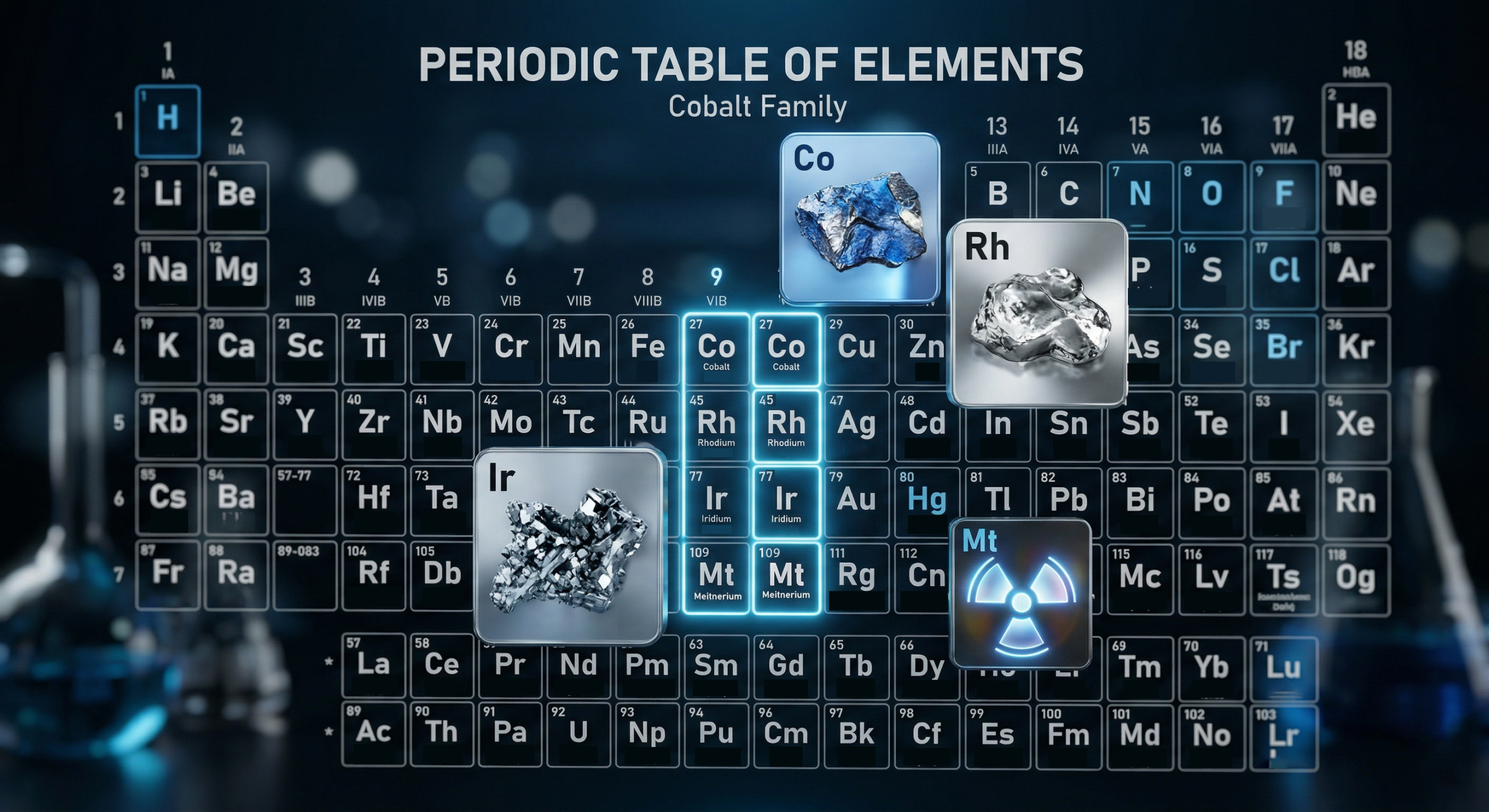
This group includes cobalt, rhodium, iridium, and the synthetic element meitnerium. These transition metals are known for their strength, durability, and catalytic power – traits that make them essential in industries ranging from energy and electronics to automotive engineering.
While they share a position on the Periodic Table, each element brings something distinct. Together, they represent a balance of practicality, rarity, and advanced chemistry.
Ready to take a deep dive into the D-block? The transition metals of Group 9 hold secrets that range from deep-blue pigments to the world’s most durable alloys. Also watch our featured video, ‘The Atomic Descent,’ and follow the Doc Scientia team as we explore the changing properties of Cobalt, Rhodium, and Iridium.
Key highlights
- Group 9 includes cobalt (Co), rhodium (Rh), iridium (Ir), and meitnerium (Mt).
- These elements are transition metals with partially filled d-orbitals.
- They exhibit multiple oxidation states, enabling diverse chemical behaviour.
- Cobalt is widely used in batteries, alloys, and pigments.
- Rhodium and iridium are rare, corrosion-resistant, and highly valuable catalysts.
- Meitnerium is a synthetic element with no practical applications.
What defines Group 9 elements?
Group 9 elements are defined by their position in the d-block and their electron structure.
They all have partially filled d-orbitals, which gives them several key characteristics:
- Variable oxidation states
- Strong metallic bonding
- Catalytic activity
- Formation of complex compounds
These properties make them highly versatile in both chemical reactions and industrial applications.
Trends across the group
Moving down Group 9, clear patterns emerge:
- Atomic mass and density increase.
- Melting and boiling points rise.
- Chemical reactivity decreases.
- Resistance to corrosion increases.
- Higher oxidation states become more stable.
Cobalt is the most reactive of the group, while iridium is among the most corrosion-resistant metals known.
Cobalt: Practical and widely used
Cobalt is the most familiar and widely used element in Group 9.

It has been used for centuries as a pigment, producing the deep blue color seen in glass and ceramics. Today, its importance has shifted toward technology.
Common uses of cobalt:
- Lithium-ion batteries (phones, laptops, electric vehicles)
- High-performance alloys for jet engines
- Permanent magnets
- Pigments and coatings
Cobalt is also biologically important – it is a key component of vitamin B12.
Rhodium: Rare and highly reflective
Rhodium is one of the rarest and most valuable metals.
It is extremely resistant to corrosion and has a highly reflective surface, making it useful in both industrial and decorative applications.
Key applications of rhodium:
- Catalytic converters (reducing vehicle emissions)
- Jewellery plating for shine and durability
- Industrial catalysts for chemical reactions

A large portion of global rhodium supply comes from South Africa, making it strategically important.
Iridium: Extreme durability
Iridium is one of the densest and most corrosion-resistant elements known.
It can withstand extreme temperatures and harsh chemical environments, which makes it valuable in specialised applications.
Where iridium is used:
- High-temperature equipment
- Electrical contacts and spark plugs
- Strengthening platinum alloys
- Advanced electronics and OLED technology

Its durability makes it ideal for conditions where most materials would fail.
Meitnerium: A synthetic element
Meitnerium is the fourth member of Group 9, but it is very different from the others.
It is a synthetic, highly radioactive element that exists only in laboratories and decays rapidly. Because of this, it has no practical applications.

Its importance lies in research, helping scientists understand the behavior of superheavy elements.
Physical and chemical properties
Group 9 elements share several defining properties:
- High density and strength
- High melting and boiling points
- Good electrical conductivity
- Resistance to wear and corrosion (especially Rh and Ir)
Chemically, they are versatile. Their ability to adopt multiple oxidation states allows them to form a wide range of compounds and act as catalysts.
Important compounds and chemistry
These elements form complex and useful compounds:
- Cobalt compounds used in pigments and catalysts.
- Rhodium complexes used in hydrogenation and hydroformylation.
- Iridium compounds used in advanced catalytic processes.
Their role in organometallic chemistry is especially important, where metal–carbon bonds enable efficient industrial reactions.
Natural occurrence and extraction
Group 9 elements vary widely in abundance:
- Cobalt is relatively common and found in nickel and copper ores.
- Rhodium and iridium are extremely rare and occur with platinum group metals.
- Meitnerium does not occur naturally.
South Africa is the leading source of rhodium and iridium, particularly from the Bushveld Complex.
Iridium is so rare it’s often used by scientists to prove that a giant asteroid once hit the Earth!
Extraction involves complex refining processes, especially for the rarer metals.
Industrial importance
Group 9 elements are critical to modern industry:
- Cobalt powers rechargeable batteries and aerospace materials.
- Rhodium reduces harmful emissions in vehicles.
- Iridium enables high-performance materials and electronics.
Their catalytic properties are especially valuable, allowing chemical reactions to occur more efficiently and sustainably.
Biological role and safety
Only cobalt has a biological function:
- It is part of vitamin B12, essential for red blood cell production.
Rhodium and iridium have no known biological role and are generally inert in metallic form, though their compounds can be hazardous.
Industrial exposure is regulated to ensure safety.
Why Group 9 matters
Group 9 elements sit at the intersection of durability, chemistry, and technology.
They strengthen the materials we rely on, clean the emissions we produce, and enable reactions that power entire industries.
From cobalt in batteries to rhodium in catalytic converters and iridium in extreme environments, this group proves that some of the most important elements aren’t the most visible – they’re the most reliable.
Frequently asked questions
Why are Group 9 elements transition metals?
Because they have partially filled d-orbitals, allowing multiple oxidation states and complex chemistry.
What are Group 9 elements used for?
Cobalt is used in batteries and alloys, rhodium in catalytic converters, and iridium in high-temperature and electronic applications.
Is cobalt essential for humans?
Yes. It is part of vitamin B12, which is necessary for proper body function.
Does meitnerium have any practical use?
No. It is a synthetic element used only for scientific research.