
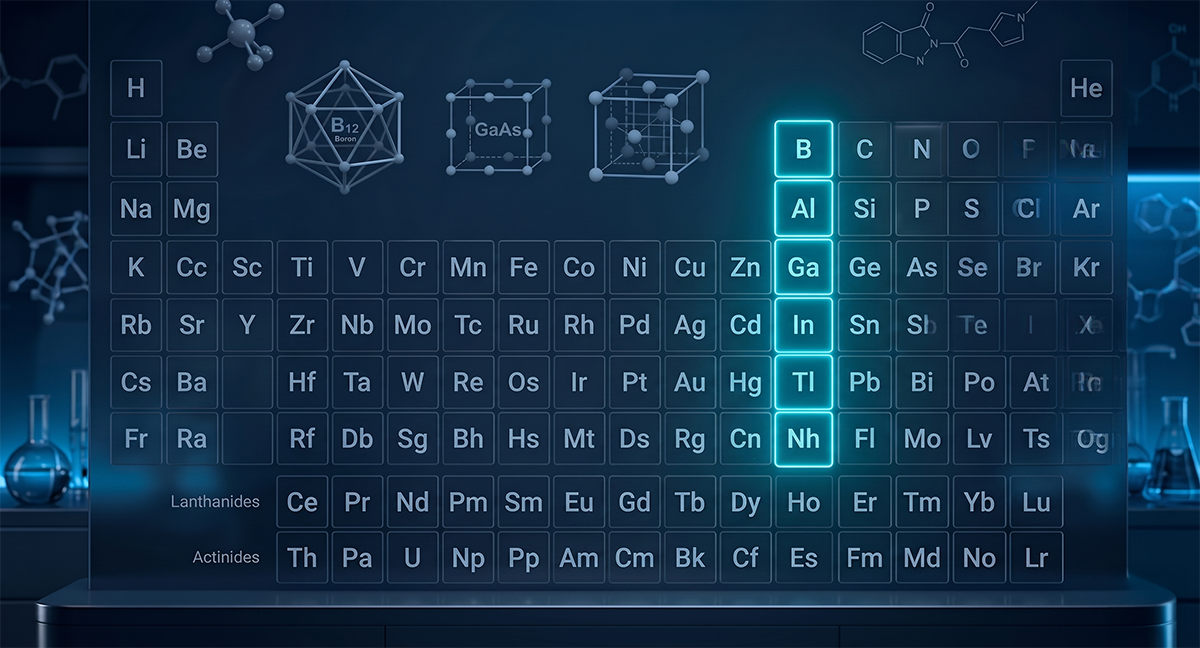
If you slide across the Periodic Table from the transition metals, you’ll land on a column that feels a little… inconsistent.
That’s Group 13.
It’s often called the boron family, but that name is slightly misleading. Families usually suggest similarity. Group 13 is more like a gradual shift – one that starts with a stubborn, nonmetal-like element at the top and ends with soft, reactive metals below.
And yet, despite those differences, these elements are deeply connected. They show up in everything from aircraft frames and kitchen foil to smartphone screens and solar panels.
So what ties them together – and why do they behave so differently?
The boron group at a glance
Group 13 consists of six elements: boron, aluminum, gallium, indium, thallium, and nihonium.
They all share the same outer electron structure – three valence electrons. That common thread is enough to group them together, but not enough to make them behave the same way.
Boron sits at the top as a metalloid, showing a mix of metallic and non-metallic behaviour. The rest – aluminum through thallium – are metals, becoming softer and more reactive as you move down. Nihonium, at the bottom, is synthetic and so unstable that most of what we know about it is theoretical.
So while they share a column, they don’t share a personality.
What defines Group 13?
In Group 13, the rules start to change as we enter the p-block. Why does having only three valence electrons lead to such a massive variety in physical states? Click here to watch ‘The Three-Electron Paradox’ and let Doc Scientia simplify the complex trends of the Boron group.
This simple pattern: three electrons in the outer shell, gives these elements a tendency to lose those electrons and form a +3 oxidation state. In lighter elements like boron and aluminum, this works well and shows up consistently in their chemistry.
But as you move down the group, things start to shift.
The outer s-electrons become more tightly held and less willing to participate in bonding – a subtle effect known as the inert pair effect. Because of this, heavier elements like thallium often settle into a +1 oxidation state instead of +3.
So even though the electron structure starts the same, the chemistry doesn’t stay that way for long.
A group defined by change
If there’s one idea that captures Group 13, it’s transition.
Boron, at the top, behaves nothing like a typical metal. It forms strong covalent bonds, builds complex structures, and resists giving up its electrons. Move one step down to aluminum, and suddenly you’re in familiar territory: a lightweight, conductive metal used everywhere from packaging to aircraft.
Further down, gallium adds a twist – it melts just above room temperature. Indium is soft and almost pliable, quietly playing a crucial role in touchscreens. Then comes thallium, which changes the chemistry again and introduces significant toxicity.
By the time you reach nihonium, you’re no longer dealing with everyday chemistry at all, but with atoms that exist for fractions of a second.
Same column. Completely different behaviour.
Boron: the exception that proves the rule
Boron doesn’t fit neatly into the rest of the group – and that’s exactly why it matters.
As a metalloid, it sits between metals and nonmetals, and its behaviour reflects that. It doesn’t readily lose electrons like the metals below it. Instead, it forms strong, directional covalent bonds, often creating complex networks.

This gives boron some unusual properties. It’s extremely hard, has a very high melting point, and behaves more like silicon than aluminum in many reactions.
You’ll find boron in places where strength, heat resistance, or precise chemistry matter – fiberglass, advanced ceramics, nuclear control rods, and even fertilisers, where it plays a role in plant growth.
It may not be as visible as aluminum, but it’s quietly essential.
Aluminum: the backbone of modern materials
If boron is the outlier, aluminum is the workhorse.
It’s one of the most abundant elements in the Earth’s crust and one of the most widely used metals in the world. What makes it so useful is its balance of properties: it’s lightweight but strong, resistant to corrosion, and a good conductor of both heat and electricity.

That’s why it shows up everywhere. In packaging, it keeps food fresh. In construction, it provides durable, rust-resistant structures. In transport, it helps reduce weight and improve efficiency.
One of its most useful traits is something you barely notice: a thin oxide layer that forms on its surface. This invisible coating protects it from further corrosion, giving aluminum its durability.
Gallium and indium: The hidden tech metals
Gallium and indium don’t get much attention – but modern technology would struggle without them.

Gallium is best known for its low melting point, but its real importance lies in semiconductors. Compounds like gallium arsenide and gallium nitride are used in LEDs, high-speed electronics, and solar cells. If you’ve used a bright LED light or a fast communication device, gallium was likely involved.
Indium works behind the scenes in a different way. Its most important compound, indium tin oxide, is both transparent and electrically conductive. That rare combination makes it essential for touchscreens, flat-panel displays, and solar panels.

You don’t see indium – but you see through it every day.
Thallium: a shift in chemistry – and risk
Thallium stands apart for a different reason.
While the earlier elements in the group favour a +3 oxidation state, thallium often prefers +1. This change reflects the inert pair effect more strongly than anywhere else in the group.
It’s also highly toxic.
Historically used in poisons and pesticides, thallium is now tightly controlled. It still has niche uses in medical imaging and specialised electronics, but handling it requires extreme care.

It’s a reminder that usefulness and danger often sit side by side in chemistry.
Nihonium: At the edge of the Periodic Table
At the bottom of Group 13 sits nihonium, a synthetic element with atomic number 113.
It doesn’t occur in nature and can only be created in particle accelerators. Even then, it exists for only fractions of a second before decaying.
Because of this, its properties are mostly predicted rather than observed. Scientists expect it to behave somewhat like a heavier version of thallium, but confirming that is a challenge.

Nihonium isn’t useful in a practical sense – but it is important. It helps researchers test the limits of atomic structure and expand our understanding of the Periodic Table.
Trends that shape the group
Even with all its variation, Group 13 does follow some clear patterns.
As you move down the group, atoms get larger and heavier. The elements become more metallic, more reactive, and generally more willing to lose electrons – though not always all of them.
Ionisation energy decreases, making it easier for atoms to form positive ions. At the same time, the inert pair effect becomes more pronounced, shifting the preferred oxidation state in heavier elements.
There are also subtle irregularities. Gallium, for instance, is slightly smaller than aluminum due to poor shielding by inner electrons – one of those small details that ends up having noticeable effects.
Chemical behaviour and bonding
Most Group 13 elements react by losing electrons and forming compounds in the +3 state. They readily combine with oxygen to form oxides, with halogens to form halides, and with acids to release hydrogen.
But boron, once again, breaks the pattern. Instead of forming simple ionic compounds, it builds covalent, electron-deficient structures and often acts as a Lewis acid.
Further down the group, bonding becomes more metallic and predictable – until thallium shifts things again with its preference for +1.
Where these elements come from
In nature, these elements don’t all behave the same way.
Aluminum is abundant and extracted from bauxite ore on a massive scale. Boron is mined from minerals like borax, often in dry regions where ancient lakes once evaporated.
Gallium, indium, and thallium are different. They rarely form their own ores and are usually recovered as byproducts during the processing of other metals like zinc.
That means their availability depends on entirely different industries – a detail that matters more than you might expect in global supply chains.
Nihonium, of course, isn’t mined at all. It’s made, atom by atom, in laboratories.
Why Group 13 matters
Group 13 doesn’t stand out because its elements are similar.
It stands out because they aren’t.
This is a group where structure stays the same – but behaviour changes dramatically. Where one element forms rigid covalent networks and another melts in your hand. Where one builds aircraft and another powers your touchscreen.
Together, they show how small changes inside the atom can lead to completely different outcomes in the real world.
And once you see that, the Periodic Table starts to feel less like a chart – and more like a story about how matter itself evolves.
Frequently asked questions
What elements are in Group 13?
Boron, aluminum, gallium, indium, thallium, and nihonium.
Why is boron so different from the rest?
Because it’s a metalloid that forms covalent bonds, unlike the metallic behaviour of the other elements.
What is the most widely used Group 13 element?
Aluminum, due to its abundance, strength, and versatility.
Why does thallium prefer a +1 oxidation state?
Because of the inert pair effect, which makes its outer s-electrons less likely to bond.
Where are gallium and indium used?
Primarily in electronics – LEDs, semiconductors, touchscreens, and solar panels.