
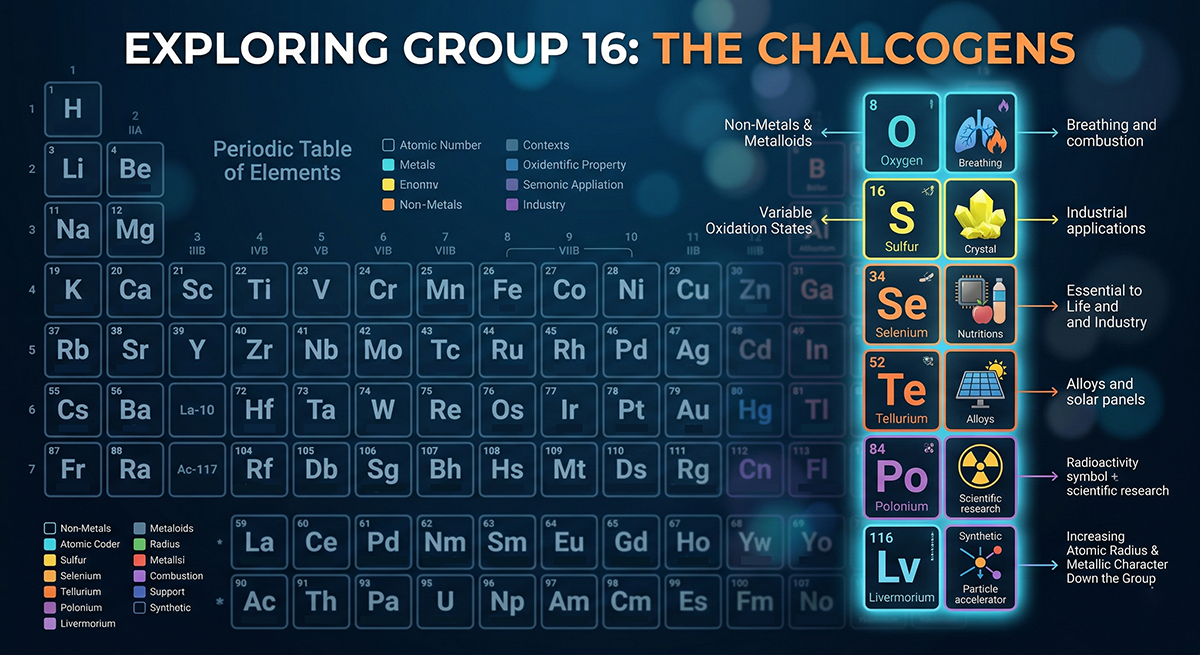
If the Periodic Table feels overwhelming, focusing on one “family” at a time makes it far more approachable. Group 16 – known as the chalcogens – is a perfect place to start. These elements quietly shape everything from the air you breathe to the technology you use.
Group 16 offers one of the most stark contrasts in all of chemistry. It begins with the Oxygen we inhale and ends with the lethal radioactivity of Polonium. Click here to watch ‘The Periodic Descent,’ where we explore how the properties of these elements shift as you move down the group.
Let’s break them down in a way that actually sticks.
What is Group 16?
Group 16 sits toward the right side of the Periodic Table and includes:
- Oxygen (O)
- Sulfur (S)
- Selenium (Se)
- Tellurium (Te)
- Polonium (Po)
- Livermorium (Lv)
They’re called chalcogens, meaning “ore-formers,” because many of them naturally occur in metal ores.
What connects them is simple: each has six valence electrons. That shared structure drives their similar behaviour – especially their tendency to gain or share two electrons in reactions.
Why this group matters
This isn’t just another column on the Periodic Table.
- Oxygen makes life possible through respiration.
- Sulfur supports agriculture and industry.
- Selenium is essential for human health.
- Tellurium helps power solar technology.
Together, they connect Biology, Chemistry, and modern industry in a very real way.
Core characteristics of Group 16 elements
All Group 16 elements share a few defining traits:
- Six valence electrons
- Common oxidation state of -2
- Increasing metallic character down the group
As you move downward, atoms get larger, less electronegative, and generally less reactive. That shift explains most of the differences you’ll see between them.
Trends you’ll actually notice
Instead of memorising data, focus on patterns:
- Atomic size increases down the group.
- Electronegativity decreases.
- Metallic behaviour becomes more noticeable.
- Melting and boiling points generally rise.
You can even see this physically: oxygen is a gas, sulfur is a yellow solid, and polonium is a dense radioactive metal.
How they bond and react
With six outer electrons, chalcogens are always “two electrons short” of stability. That leads to predictable Chemistry:
- They form -2 ions (like O²⁻ in water).
- They create covalent bonds in molecules like CO₂.
- Some, like sulfur, form chains and rings (catenation).
Oxygen is the most reactive of the group. As you move down, reactivity drops and Chemistry becomes more flexible.
Meet the elements
Oxygen: the life enabler
Oxygen makes up about 21% of Earth’s atmosphere and is essential for respiration. It also forms ozone (O₃), which protects us from harmful UV radiation.

Sulfur: the industrial workhorse
Bright yellow and versatile, sulfur is used in fertilisers, chemicals, and rubber production. It’s one of the most widely used industrial elements.

Selenium: small but essential
Selenium supports thyroid function, immunity, and antioxidant activity. It also has uses in glassmaking and electronics.

Tellurium: the tech contributor
Rare but important, tellurium is used in solar panels and thermoelectric devices, making it valuable in clean energy.

Polonium: powerful and dangerous
Highly radioactive and toxic, polonium is mainly limited to specialised scientific uses.

Livermorium: the newcomer
A short-lived synthetic element, livermorium exists only in labs and helps scientists study superheavy atoms.

A deeper look: Why this group is so interesting
There’s something almost poetic about Group 16. It’s a family that sits on the edge – between life and toxicity, simplicity and complexity.
Oxygen keeps you alive. Sulfur, in the wrong form, signals decay. Yet both follow the same underlying rules. The difference comes down to structure and context.
Some of their behaviour is surprisingly complex. Sulfur, for instance, can bond with itself to form rings and long chains. Melt it, and it can turn into a thick, tangled liquid that behaves more like a polymer than a typical element.
Oxygen has its own dual personality. In the form we breathe (O₂), it’s stable and essential. Rearranged as ozone (O₃), it becomes highly reactive – protective in the upper atmosphere, but harmful closer to the ground.
Selenium adds another layer. It’s both a biological necessity and a material used in light-sensitive electronics. Few elements sit so comfortably between living systems and technology.
As you move further down, the tone shifts. Tellurium and polonium become more metallic, more unstable, and in polonium’s case, dangerously radioactive. It’s a stark contrast to oxygen at the top – but part of the same family.
That gradual shift – from life-supporting to hazardous – is what makes Group 16 so compelling. It’s not a fixed category. It’s a spectrum.
A quick note on “L”
Most Group 16 symbols don’t include the letter “L.” The exception is livermorium (Lv), named after Lawrence Livermore National Laboratory. Beyond that, “L” appears in science mainly as a symbol (like litres), not as a defining feature of this group.
Real-world impact
Chalcogens show up everywhere once you start looking:
- Water (H₂O) and air (O₂)
- Fertilisers that support food production
- Solar panels generating clean energy
- Biological processes inside your body
Even environmental issues like acid rain trace back to their Chemistry.
In Conclusion
Group 16 is a reminder that the Periodic Table isn’t just a chart – it’s a pattern of relationships. A single shared feature – six valence electrons – leads to an incredible range of outcomes, from sustaining life to powering modern technology.
Once you see that pattern, the whole table starts to feel a lot more human.
Frequently Asked Questions (FAQ)
Why are Group 16 elements called chalcogens?
The name chalcogen comes from Greek and means “ore-former.” It reflects how elements like oxygen and sulfur are commonly found combined with metals in natural ores. Many important minerals – like iron oxides or metal sulfides – exist because of these elements.
Why do Group 16 elements usually form a -2 charge?
They’re just two electrons short of a full outer shell.
With six valence electrons, chalcogens tend to gain two more to become stable. That’s why oxygen forms O²⁻ in compounds like water or metal oxides. It’s the simplest way for them to “complete” their electron configuration.
Why is oxygen so much more reactive than the others?
It comes down to size and electronegativity.
Oxygen is small and strongly attracts electrons, which makes it highly reactive. As you move down the group, atoms get larger and their pull on electrons weakens – so elements like sulfur and selenium are less reactive by comparison.
Why does sulfur form chains and rings?
Sulfur is particularly good at bonding with itself – a property called catenation.
Unlike oxygen, sulfur atoms can link together to form long chains or ring structures (like S₈). This happens because sulfur-sulfur bonds are relatively stable, allowing for more complex structures.
Why is oxygen a gas but sulfur a solid?
It’s about how the atoms are arranged.
Oxygen exists as small O₂ molecules with weak forces between them, so it stays a gas at room temperature. Sulfur, on the other hand, forms larger S₈ molecules with stronger intermolecular forces, making it a solid.
Are all Group 16 elements nonmetals?
No – and that’s part of what makes the group interesting.
- Oxygen and sulfur are nonmetals.
- Selenium and tellurium are metalloids.
- Polonium behaves like a metal.
As you go down the group, metallic character increases.
Is ozone (O₃) the same as oxygen we breathe?
Not quite.
Both are made of oxygen, but their structures are different:
- O₂ (oxygen gas) is stable and essential for breathing.
- O₃ (ozone) is more reactive.
In the upper atmosphere, ozone protects us from UV radiation. At ground level, though, it can be harmful to lungs.
Why are some Group 16 elements toxic?
It depends on their form and reactivity.
Oxygen is essential for life, but compounds of heavier elements – like polonium – can be highly toxic or radioactive. Even sulfur compounds (like hydrogen sulfide) can be dangerous in certain conditions.
So toxicity isn’t about the group as a whole – it’s about specific elements and how they’re used.
Where do we see Group 16 elements in everyday life?
Pretty much everywhere:
- Breathing (oxygen in air)
- Drinking water (H₂O)
- Fertilisers and agriculture (sulfur compounds)
- Electronics and solar panels (selenium and tellurium)
They’re deeply woven into both natural systems and modern technology.
Why is livermorium not commonly discussed?
Because it barely exists.
Livermorium is a synthetic element made in laboratories, and it decays almost instantly. Scientists study it to understand atomic structure, but it doesn’t have practical, everyday uses like the other elements in the group.
What makes Group 16 different from Group 15?
It’s just one extra electron – but it changes everything.
- Group 15 elements have five valence electrons.
- Group 16 elements have six.
That difference means Group 16 elements typically form two bonds instead of three, and they tend to gain two electrons instead of three. It shapes their Chemistry in a big way.
Why do melting and boiling points increase down the group?
As atoms get larger, the forces between them get stronger.
Heavier elements like tellurium and polonium have more electrons, which increases intermolecular attraction. That’s why they require more heat to melt or boil compared to oxygen.