
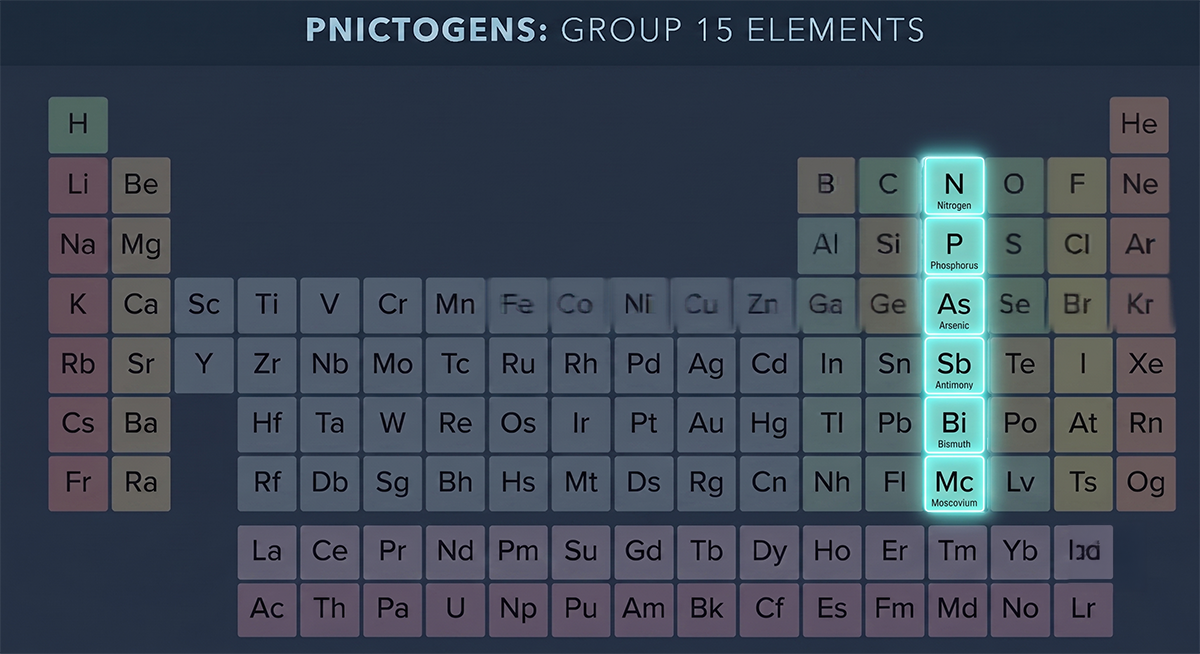
If there’s one group on the Periodic Table that really shows how diverse Chemistry can be, it’s Group 15. Also called the pnictogens, this family stretches from invisible gases in the air to dense, metallic solids used in medicine and industry.
Let’s unpack it in a way that actually makes sense – and sticks.
What is Group 15?
Group 15 includes:
- Nitrogen (N)
- Phosphorus (P)
- Arsenic (As)
- Antimony (Sb)
- Bismuth (Bi)
- Moscovium (Mc)
They all share five valence electrons (ns²np³), which shapes how they bond and react. Most tend to form three covalent bonds, though heavier elements can behave differently.
The name pnictogen comes from Greek, loosely meaning “to choke” – a nod to nitrogen gas, which can displace oxygen and cause suffocation in enclosed spaces.
Why this group matters
Group 15 quietly underpins both life and technology:
- Nitrogen is essential for proteins and DNA.
- Phosphorus drives energy transfer (ATP).
- Arsenic and antimony are key in electronics.
- Bismuth offers a safer alternative to toxic metals like lead.
It’s a group where Biology, Chemistry, and industry all intersect.
Core characteristics (without overcomplicating it)
Here’s what ties them together:
- Five valence electrons
- Common oxidation states: -3, +3, +5
- A clear shift from nonmetal → metalloid → metal down the group
As you move downward, atoms get larger, electronegativity drops, and metallic character increases. That one trend explains most of their changing behaviour.
Trends you’ll actually notice.
Instead of memorising numbers, focus on the patterns:
- Atomic size increases down the group.
- Ionisation energy and electronegativity decrease.
- Metallic behaviour becomes more pronounced.
- Bonding shifts from strong covalent (top) to more metallic (bottom).
You can even see it physically: nitrogen is a gas, phosphorus is a reactive solid, and bismuth is a heavy metal.
How they bond and react
With five outer electrons, these elements are three electrons short of a full octet. That leads to flexible Chemistry:
- They form covalent bonds (like NH₃ or PCl₃).
- They can gain three electrons (forming -3 ions).
- Heavier elements often prefer +3 due to the inert pair effect.
Nitrogen stands out – it forms extremely strong triple bonds (N≡N), which makes it surprisingly unreactive as a gas.
Meet the elements
Nitrogen: the quiet essential
Making up about 78% of Earth’s atmosphere, nitrogen is everywhere – but mostly inert. Its real importance shows up in compounds like ammonia, which fuels agriculture, and in the molecules that make up life itself.

Phosphorus: reactive and vital
Phosphorus is never found free in nature because it reacts so easily. It exists in multiple forms, from highly reactive white phosphorus to stable red phosphorus used in safety matches. It’s also critical in fertilisers and DNA.

Arsenic: useful but toxic
Arsenic sits in the middle as a metalloid. It’s infamous for its toxicity, but it also plays a role in semiconductors and glass production. Like many elements, it’s dangerous in the wrong context and useful in the right one.

Antimony: the industrial helper
Often overlooked, antimony strengthens alloys and is widely used in flame retardants and electronics. It behaves like a bridge between metalloids and metals.

Bismuth: the safer heavy metal
Bismuth is dense, metallic, and surprisingly non-toxic. It’s used in medicines (like Pepto-Bismol), cosmetics, and as a replacement for lead in environmentally safer materials.

Moscovium: the lab-made outlier
A synthetic, short-lived element, moscovium exists only for fractions of a second in labs. Scientists study it to understand the limits of atomic stability.

A deeper look: what makes Group 15 interesting?
Group 15 is full of contrasts.
Nitrogen is essential for life – but as a pure gas, it’s almost inert. Phosphorus, just below it, is so reactive it can ignite in air. Same group, completely different behaviour.
That contrast comes down to bonding. Nitrogen forms one of the strongest bonds in Chemistry (a triple bond), locking it into stability. Phosphorus, with weaker bonding, is far more reactive and versatile.
Then there’s the middle of the group – arsenic and antimony – where things get blurred. They’re not quite metals, not quite nonmetals. Their semiconductor properties make them especially valuable in electronics.
By the time you reach bismuth, you’re fully in metallic territory. But even here, there’s a twist: unlike many heavy metals, bismuth is relatively safe. It’s a rare case where moving down the Periodic Table doesn’t just mean “more dangerous.”
That gradual shift – from essential to toxic to useful again – is what makes this group feel less like a category and more like a spectrum.
Allotropes and variety
Some Group 15 elements exist in multiple forms, and the differences are dramatic.
Phosphorus is the standout:
- White phosphorus: toxic, highly reactive, glows in the dark.
- Red phosphorus: stable and used in matches.
- Black phosphorus: structured like graphite and more stable.
Arsenic shows similar behaviour, with metallic grey arsenic being the most stable form.
Same element, different structure – completely different properties.
Real-world impact
Once you notice Group 15, you see it everywhere:
- Fertilisers feeding global agriculture (nitrogen, phosphorus).
- Electronics powered by semiconductors (arsenic, antimony).
- Medicines and cosmetics (bismuth compounds).
- Industrial chemicals like ammonia and nitric acid.
Even environmental issues – like water pollution or toxic exposure – often trace back to this group.
Final thoughts
Group 15 is a great example of how the Periodic Table tells a story. A single shared feature – five valence electrons – leads to an incredible range of behaviours, from life-sustaining Chemistry to advanced materials and toxic hazards.
Once you see the pattern, the differences stop feeling random. They start to feel inevitable.
Frequently Asked Questions (FAQ)
Why do Group 15 elements form multi-atom (polyatomic) molecules?
Short answer: they’re built for it.
Group 15 elements have five valence electrons, which means they’re just three electrons short of a full outer shell. That gives them flexibility – they can form multiple covalent bonds in different ways, often linking up with other atoms (or even with themselves).
Nitrogen, for example, forms a simple two-atom molecule (N₂) with a very strong triple bond. Phosphorus, on the other hand, prefers to form clusters like P₄, where four atoms bond together in a tetrahedral shape.
As you move down the group, bonding becomes a bit less rigid and more varied. That’s why you start seeing more complex structures and compounds. In short, their electron setup makes them naturally good at forming stable, multi-atom arrangements.
What’s the difference between monoatomic and polyatomic?
It comes down to how many atoms are involved.
- Monoatomic means a substance exists as single, individual atoms.
- Polyatomic means two or more atoms are chemically bonded together.
For Group 15, nitrogen gas (N₂) is actually diatomic (a type of polyatomic), while something like a nitrate ion (NO₃⁻) is a more complex polyatomic structure.
These multi-atom groups show up everywhere – especially in biology and environmental Chemistry. Think DNA (nitrogen-based), fertilisers (nitrates and phosphates), and even explosives.
Do all Group 15 elements behave the same way?
Not even close – and that’s what makes them interesting.
They share the same number of valence electrons, but their behavior changes a lot as you move down the group. Nitrogen is a stable gas, phosphorus is reactive, arsenic is toxic, and bismuth is a relatively safe metal.
Same “family,” very different personalities.
Why is nitrogen so unreactive compared to the others?
It’s all about the bond.
Nitrogen forms a triple bond (N≡N), which is one of the strongest in Chemistry. Breaking that bond takes a lot of energy, so nitrogen gas doesn’t react easily under normal conditions.
That’s why it can make up 78% of the air without constantly reacting with everything around it.
Why do heavier Group 15 elements prefer the +3 oxidation state?
This comes down to something called the inert pair effect.
As atoms get larger, their inner electrons (especially the s-electrons) are held more tightly and don’t participate in bonding as easily. So instead of using all five valence electrons (+5 state), heavier elements like bismuth often “settle” for using three (+3 state).
It’s a subtle shift, but it has a big impact on their Chemistry.
Which Group 15 elements are dangerous?
A few of them definitely require caution.
- Arsenic is highly toxic and historically known as a poison.
- Some phosphorus forms (like white phosphorus) are extremely reactive and harmful.
- Antimony compounds can also be toxic in certain forms.
On the flip side, bismuth is considered relatively safe and is even used in medicine.
So it’s not a “dangerous group” – just one with a wide range of behaviors.
Where do we actually use Group 15 elements in everyday life?
More places than you’d expect:
- Fertilisers (nitrogen and phosphorus compounds)
- Medicines (bismuth in digestive treatments)
- Electronics (arsenic and antimony in semiconductors)
- Food and biology (nitrogen in proteins and DNA)
They’re quietly involved in both life and technology.
What makes Group 15 different from Group 16?
It mostly comes down to electrons.
- Group 15 has five valence electrons.
- Group 16 has six.
That one-electron difference changes everything. Group 15 elements tend to form three bonds, while Group 16 elements typically form two. It also affects their reactivity, oxidation states, and the types of compounds they form.
Small change, big consequences.
Why is phosphorus never found freely in nature?
Because it’s too reactive to stay that way.
Phosphorus quickly forms compounds with oxygen and other elements, so you’ll usually find it as phosphate minerals instead of in its pure form. It’s constantly “locked” into something more stable.
That’s why we have to extract it from ores for industrial use.