
Some groups in the Periodic Table are easy to define. The elements look alike, behave alike, and follow neat, predictable patterns.
Group 14 isn’t one of them.
Known as the carbon family, this group stretches from one of the most essential elements for life – carbon – all the way down to heavy metals like lead, and finally to a synthetic element that barely exists long enough to study.
It’s less a tidy group and more a journey. One that moves from non-metals to metalloids to metals, from biology to electronics to heavy industry.
And along the way, it quietly shapes almost everything around us.
The carbon group at a glance
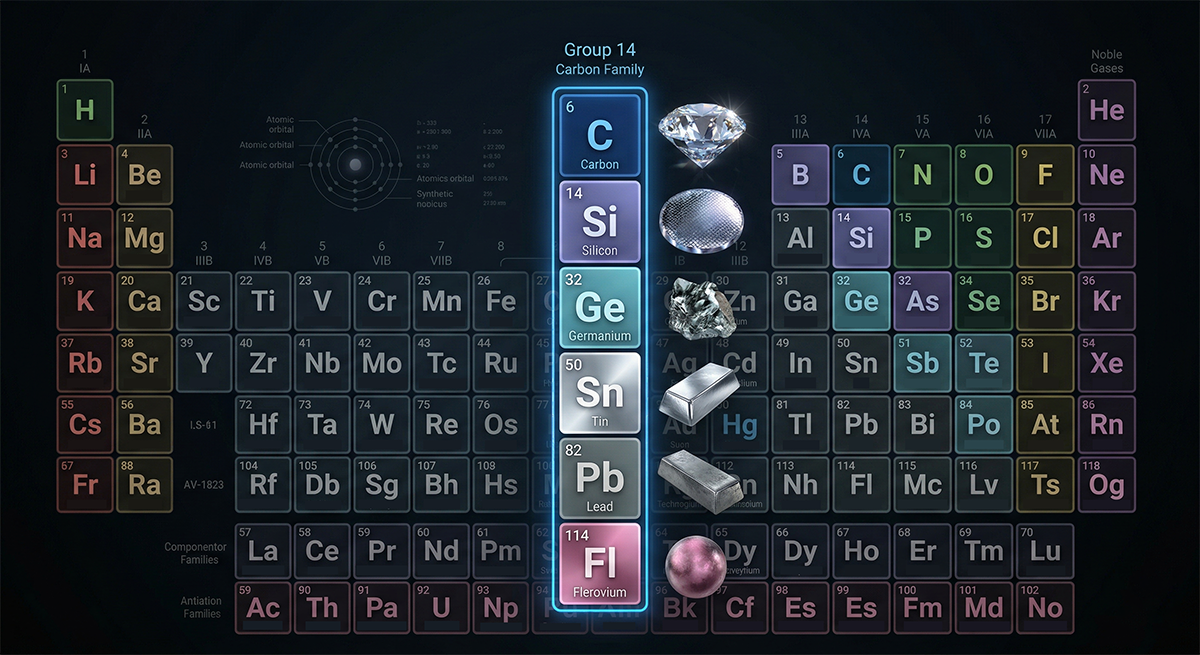
Group 14 includes carbon (C), silicon (Si), germanium (Ge), tin (Sn), lead (Pb), and flerovium (Fl).
What links them is their electron structure. Each has four electrons in its outer shell – enough to form four covalent bonds. This property, known as tetravalency, is what gives the group its versatility.
But that shared structure doesn’t mean identical behaviour.
At the top, carbon forms the backbone of life. In the middle, silicon and germanium power modern electronics. At the bottom, tin and lead behave like traditional metals, used in manufacturing and heavy industry.
Same group. Very different roles.
What defines Group 14?
The defining feature of Group 14 is simple: four valence electrons.
That gives these elements flexibility. They can form multiple bonds, build long chains, and exist in different oxidation states – most commonly +4 and +2.
In lighter elements like carbon and silicon, the +4 state dominates. But as you move down the group, the +2 state becomes more stable. This shift is caused by the inert pair effect, where two of the outer electrons become less available for bonding.
So while the structure stays consistent, the chemistry evolves.
If you want to see the diversity of the Periodic Table in a single glance, look no further than Group 14. It is a literal ‘gradient’ of properties, shifting from the life-giving non-metal Carbon to the heavy, dense metal Lead. Have a look our featured video, ‘The Gradient of Matter,’ and follow the Doc Scientia team as we break down the fascinating transition from non-metal to metal.
A group built on change
Group 14 is one of the clearest examples of how properties shift across the Periodic Table.
Carbon is a non-metal, forming strong covalent bonds and complex molecules. Silicon and germanium sit in the middle as metalloids, balancing between metallic and non-metallic behaviour. Tin and lead, further down, are fully metallic – soft, dense, and more reactive in different ways.
It’s a smooth transition, but the effects are dramatic.
You move from the chemistry of life… to the chemistry of semiconductors… to the chemistry of heavy metals – all in a single column.
Carbon: The foundation of life and materials
Carbon isn’t just another element – it’s the element that makes life possible.
Its ability to bond with itself, known as catenation, allows it to form chains, rings, and complex structures. This is why it sits at the centre of organic chemistry and why it appears in everything from DNA to plastics.
But carbon isn’t limited to biology.

It exists in several forms, each with completely different properties. Diamond is one of the hardest materials known, with a rigid three-dimensional structure. Graphite, by contrast, is soft and slippery, made of layers that slide over each other. Then there’s graphene, a single layer of carbon atoms that’s incredibly strong and highly conductive.
Few elements show this level of versatility.
Silicon: The backbone of the digital world
If carbon defines life, silicon defines technology.
It’s one of the most abundant elements in the Earth’s crust and the foundation of modern electronics. Its ability to act as a semiconductor – sometimes conducting electricity, sometimes not – is what makes it ideal for microchips, transistors, and solar cells.

Silicon also forms silicon dioxide (SiO₂), better known as silica. This compound is found in sand and is essential for glass, concrete, and countless construction materials.
What makes silicon especially useful is its stability. It forms a protective oxide layer that allows precise control in electronic devices – something germanium, despite its similar proerties, doesn’t do as effectively.
Germanium: The quiet specialist
Germanium often sits in silicon’s shadow – but it still plays an important role.
It was one of the first elements used in early transistors before silicon took over. Today, it’s used in more specialised areas, particularly where its optical properties matter.
Germanium is transparent to infrared light, making it valuable in:
- Fiber optics
- Thermal imaging
- Infrared optics
It also appears in high-speed electronics, where its smaller band gap allows faster signal processing.

It’s less common, more expensive, and used more selectively – but still essential in the right contexts.
Tin and lead: The metallic end of the group
By the time you reach tin and lead, the chemistry has shifted fully into metallic territory.
Tin is soft, corrosion-resistant, and easy to work with. It’s widely used in soldering – joining electronic components – and in coatings that protect other metals from rust. Historically, it played a key role in bronze, one of the earliest important alloys.

Lead is heavier, denser, and far more controversial.
It’s been used for centuries in pipes, paints, and batteries. Today, its use is more restricted due to its toxicity. Still, it remains important in specific areas, especially in lead-acid batteries and radiation shielding.

These elements reflect the heavier, more industrial side of Group 14.
Flerovium: Chemistry at the edge
At the bottom of the group sits flerovium, a synthetic element with atomic number 114.
It doesn’t occur naturally and can only be created in laboratories. Even then, it exists for mere seconds before decaying.
Because of this, its properties are largely predicted rather than observed. Scientists believe it may behave like a very heavy metal, but confirming that is difficult.

Flerovium doesn’t have practical uses – but it does push the boundaries of what we know about atomic structure.
Trends across the group
Despite its variety, Group 14 follows some clear trends.
As you move down the group, atoms become larger and heavier. Metallic character increases, while ionisation energy decreases. This makes it easier for heavier elements to lose electrons – but not always all of them, thanks to the inert pair effect.
Melting points show a general decline from carbon’s extremely high values to much lower ones in lead. Density increases, and bonding shifts from strong covalent networks to more metallic interactions.
There are exceptions and irregularities – but that’s part of what makes the group interesting.
Chemical behaviour and bonding
Group 14 elements are known for forming covalent bonds, especially in their lighter members.
Carbon leads the way, forming stable single, double, and triple bonds. Silicon and germanium also form covalent networks, though less extensively. Further down, bonding becomes more metallic, especially in tin and lead.
Oxidation states vary as well. Carbon can range from –4 to +4, while heavier elements tend to favour +2 and +4, with +2 becoming more stable lower in the group.
This flexibility allows the group to form an enormous range of compounds – from simple gases like CO₂ to complex silicates and industrial materials.
Where these elements show up
Group 14 elements are deeply embedded in both natural systems and modern industry.
Carbon cycles through the environment as carbon dioxide and organic matter. Silicon dominates the Earth’s crust in the form of minerals and sand. Germanium appears in trace amounts, often as a byproduct of other mining processes.
Tin and lead are found in mineral ores and have long histories in human use, from ancient tools to modern batteries.
In countries like South Africa, these elements support industries ranging from mining and construction to energy and electronics.
Why Group 14 matters
Group 14 isn’t defined by similarity – it’s defined by transformation.
It shows how a single electron pattern can produce completely different outcomes. From the chemistry of life to the foundations of digital technology to the realities of heavy industry, this group connects some of the most important systems we rely on.
Carbon builds living things. Silicon powers our devices. Tin and lead support manufacturing. And elements like germanium quietly enable the technologies we rarely think about.
Put together, they tell a bigger story.
Not just about elements – but about how small changes at the atomic level shape the world we live in.
A South African perspective on Group 14
Group 14 isn’t just a story told in textbooks – it shows up quite clearly in South Africa’s landscape and industries.
Silicon, for example, is everywhere, though not always in a form you’d immediately recognise. Much of South Africa’s terrain is rich in silica (SiO₂), found in quartz and sand. These materials feed directly into glass manufacturing, construction, and even high-temperature industrial processes. In regions with strong mining and materials sectors, silicon-based compounds quietly support everything from buildings to infrastructure.
Then there’s carbon, which plays a particularly important role in South Africa’s energy story. The country has long relied on coal – essentially carbon in a complex form – as a primary energy source. This has powered economic development for decades, but it also places South Africa right in the middle of global conversations about carbon emissions, sustainability, and the transition to cleaner energy. In that sense, carbon isn’t just a chemical element here – it’s part of a much bigger environmental and economic balancing act.
On the heavier end of the group, lead and tin have also appeared in South Africa’s mining history, though less prominently than gold or platinum. Lead, in particular, still finds use in batteries, including those tied to backup power systems – something that has become increasingly relevant in a country managing energy reliability challenges.
Taken together, Group 14 elements don’t just exist in isolation – they’re woven into South Africa’s natural resources, its industries, and even its future energy decisions.
Carbon, diamonds, and South Africa
If there’s one place where Group 14 connects directly to South Africa in a powerful, almost iconic way, it’s through carbon – and more specifically, diamonds.
Diamonds are pure carbon, arranged in a tightly bonded three-dimensional lattice. This structure makes them incredibly hard, giving them both industrial value and their well-known status as gemstones. What’s remarkable is that this brilliance and strength come from the same element that also forms soft graphite or even the carbon in living organisms.
South Africa has played a central role in the global diamond industry since the discovery of diamonds in Kimberley in the late 1800s. That discovery didn’t just spark a mining boom – it helped shape the country’s economic history and positioned it as a major player in the global gemstone market.
Beyond jewellery, diamonds have important industrial uses as well. Because of their hardness, they are used in cutting tools, drilling equipment, and precision machining – applications that are essential in mining and manufacturing sectors.
So while Group 14 spans everything from semiconductors to heavy metals, in South Africa, carbon’s diamond form stands out. It’s a clear example of how an element’s atomic structure can translate into real-world impact – economically, historically, and scientifically.
Frequently asked questions
What elements are in Group 14?
Carbon, silicon, germanium, tin, lead, and flerovium.
Why is carbon so important?
Because it can form complex, stable bonds, making it the foundation of all known life and organic chemistry.
What is silicon used for?
Primarily in electronics (semiconductors) and in materials like glass and concrete.
Why do heavier elements prefer +2 oxidation states?
Due to the inert pair effect, which makes some outer electrons less likely to participate in bonding.
Where is germanium used?
In fiber optics, infrared optics, and specialised electronics.