
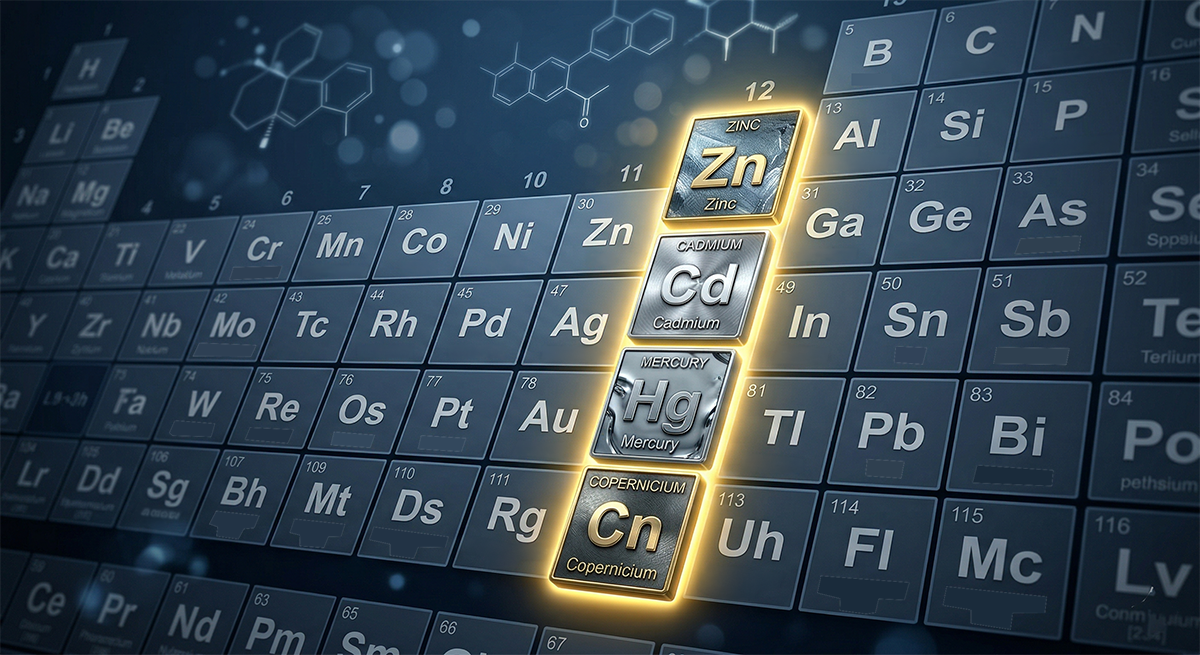
Group 12 doesn’t shout for attention.
It sits quietly toward the end of the transition metals, often overlooked, sometimes misunderstood. But look a little closer, and this group turns out to be one of the most intriguing in the Periodic Table.
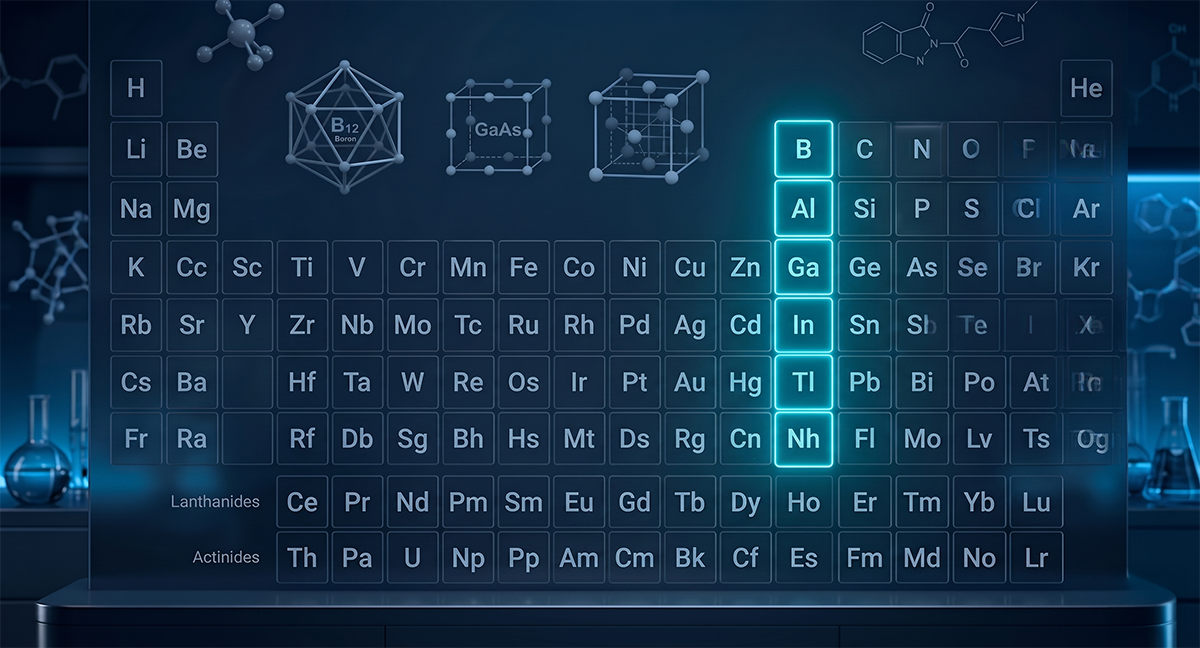
It includes zinc, cadmium, mercury, and copernicium – elements that share a similar structure but lead very different lives. One supports human biology. Two come with serious health risks. And one exists only for a fraction of a second in a lab.
What ties them together isn’t dramatic reactivity or bold chemistry, but something subtler: stability, restraint, and, in one case, a complete break from expectation.
Not quite typical transition metals
On paper, Group 12 sits in the d-block, which would normally make its members transition metals.
In practice, they don’t quite behave like the rest.
Their defining feature is a completely filled d-subshell. This might sound like a small detail, but it changes everything. Unlike many transition metals that show a wide range of oxidation states and colourful compounds, Group 12 elements are far more predictable.
Most of the time, they form +2 ions. Their chemistry is simpler, their compounds often colourless, and their reactivity more controlled.
Because of this, some chemists argue that they don’t fully qualify as “true” transition metals at all. They sit in the right place – but behave a little differently.
A group full of contrasts
Despite their shared structure, the elements in Group 12 don’t feel like variations of the same theme.
Zinc is stable, useful, and essential for life. Cadmium looks similar on the surface but carries significant toxicity. Mercury breaks one of the most basic expectations in chemistry by being liquid at room temperature. Copernicium, at the bottom, barely exists long enough to study.
It’s a group where small changes in atomic structure lead to surprisingly large differences in behaviour.
Group 12 is a journey of extremes. It bridges the gap between the minerals our bodies need to survive and the heavy metals that can be incredibly dangerous. Click here to watch ‘Descending Group 12: From Essential to Deadly’ and master the changing properties of Zinc, Cadmium, and Mercury with Doc Scientia.
Trends that don’t quite behave
If you scan down the group, some patterns emerge – but they’re not as neat as in other columns.
Atoms become heavier and denser, as expected. But melting points drop instead of rising, culminating in mercury, which is liquid under standard conditions. Metallic bonding weakens as you move downward, which helps explain this unusual shift.
Reactivity changes only slightly, and overall, these elements remain relatively moderate in how they interact with other substances.
It’s not a dramatic trend – but it’s an unusual one.
Zinc: Quiet but essential
Zinc rarely gets the spotlight, but it plays a surprisingly important role in both industry and biology.
In everyday life, it’s everywhere – coating steel to prevent rust, strengthening alloys like brass, and powering certain types of batteries. It’s valued because it strikes a balance: reactive enough to be useful, but stable enough to be reliable.
But zinc’s real significance shows up inside the human body.
It’s an essential trace element, involved in enzyme function, immune response, and cell growth. Without it, key biological processes simply don’t work properly.

Few elements manage to bridge industrial utility and biological necessity so seamlessly.
Cadmium: A cautionary counterpart
Cadmium sits just below zinc and, at first glance, looks similar.
Chemically, it behaves in comparable ways. It forms similar compounds and appears in similar industrial contexts. But there’s a critical difference – cadmium is highly toxic.
It has been used in rechargeable batteries, protective coatings, and pigments known for their vivid yellows and reds. For a time, it was valued for these properties.
But over the years, its risks became clear. Cadmium accumulates in the body, damaging organs and weakening bones. As a result, its use is now tightly controlled, and in many cases, reduced or replaced.

It’s a reminder that chemical similarity doesn’t always mean similar impact.
Mercury: The rule breaker
Mercury is where Group 12 becomes impossible to ignore.
It’s the only metal that is liquid at room temperature – a fact that feels almost counterintuitive if you’re used to thinking of metals as solid, rigid materials.
This unusual state comes down to weak metallic bonding between mercury atoms, influenced by relativistic effects. In simple terms, its electrons behave differently because of the element’s high atomic number, which weakens the forces holding the atoms together.
The result is a dense, silvery liquid that flows like water but conducts electricity like a metal.

Historically, mercury was used in thermometers, barometers, electrical switches, and even gold extraction through the formation of amalgams. But its toxicity – especially in vapor form – has led to strict global regulations.
Today, its use is limited, and its risks are well recognised.
Still, from a scientific perspective, mercury remains one of the most fascinating elements in the table.
Copernicium: Chemistry at the edge
At the bottom of the group is copernicium, element 112.
It doesn’t occur naturally and can only be created in highly controlled laboratory conditions. Even then, it exists for only seconds before decaying.
What makes copernicium especially interesting is that it may not behave like a typical metal at all. Some predictions suggest it could act more like a gas under certain conditions, again due to relativistic effects.
But with so little experimental data, much of what we know remains theoretical.

Copernicium isn’t useful in a practical sense – but it pushes the boundaries of how we understand elements at the extreme end of the Periodic Table.
A closer look at their Chemistry
Group 12 elements are defined by consistency more than variety.
They overwhelmingly prefer the +2 oxidation state. Zinc and cadmium follow this pattern almost exclusively, forming stable compounds with oxygen, sulfur, and halogens. Mercury is slightly more complex, capable of forming both +1 and +2 states, often in unique bonded pairs.
Because their d-orbitals are filled, their compounds tend to lack the vivid colours seen in other transition metals. Their bonding is more straightforward, often leaning toward ionic or simple covalent interactions.
This predictability is part of what makes zinc so useful – and cadmium and mercury manageable, at least under controlled conditions.
Where these elements come from
In nature, Group 12 elements appear in very different ways.
Zinc is commonly found in ores such as sphalerite and is mined on a large scale. Cadmium is usually obtained as a byproduct of zinc refining rather than mined directly. Mercury comes primarily from cinnabar, a bright red ore that has been used since ancient times.
Copernicium, of course, doesn’t occur naturally at all.
Extracting and processing these elements requires careful handling, especially for cadmium and mercury, where environmental and health concerns are significant.
The environmental and human side
This group also highlights the double-edged nature of Chemistry.
Zinc is beneficial – even essential – in small amounts. It supports life and improves materials we rely on every day.
Cadmium and mercury, on the other hand, show how elements can become dangerous when mismanaged. Both can accumulate in ecosystems, particularly in water, and move through food chains, causing long-term harm.
Because of this, modern industry places strong emphasis on regulation, recycling, and safer alternatives.
It’s not just about what elements can do – but how responsibly they’re used.
Why Group 12 matters
Group 12 isn’t about extremes. It’s not the most reactive, the most colourful, or the most abundant.
What it offers instead is a lesson in nuance.
These elements show how small changes in atomic structure can lead to completely different outcomes – from essential nutrients to toxic hazards, from solid metals to flowing liquids, from stable materials to barely detectable atoms.
Zinc quietly supports life and industry. Cadmium and mercury remind us of the cost of ignoring chemical risks. Copernicium challenges the limits of what we can even observe.
Taken together, Group 12 tells a quieter story – but it’s one that matters just as much.
Frequently asked questions
What elements are in Group 12?
Zinc, cadmium, mercury, and copernicium.
Are Group 12 elements transition metals?
They are in the d-block, but many chemists classify them separately because of their filled d-orbitals and limited oxidation states.
Why is mercury liquid at room temperature?
Because of weak metallic bonding influenced by relativistic effects on its electrons.
Is zinc important for humans?
Yes. It is an essential trace element required for many biological processes.
Are cadmium and mercury dangerous?
Yes. Both are toxic and require careful handling and strict environmental controls.