
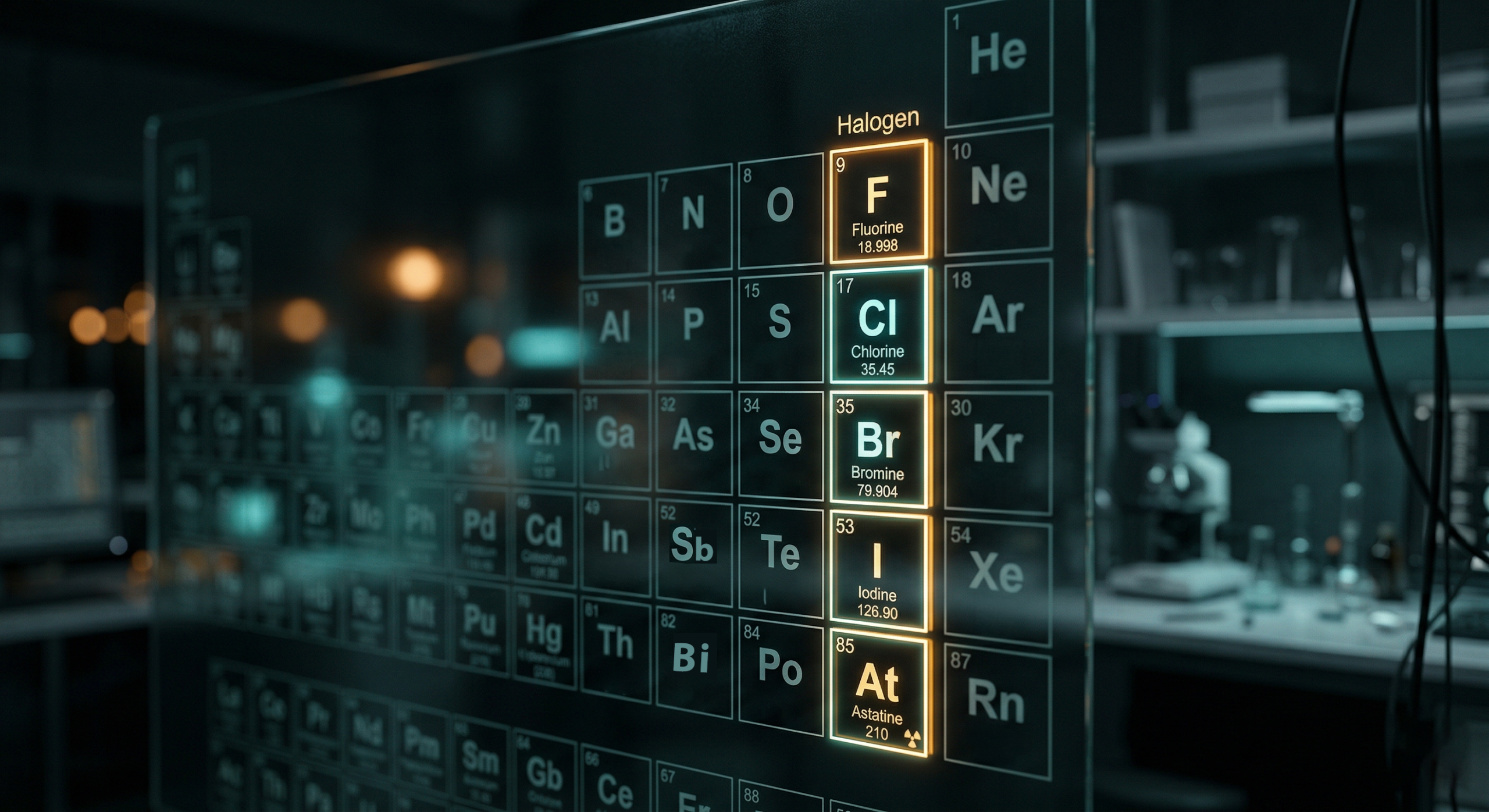
If Group 6 is about strength, Group 7 is about reactivity.
These elements – known as the halogens – are some of the most chemically active substances on the Periodic Table. Fluorine, chlorine, bromine, iodine, and astatine all share one defining trait: they’re just one electron short of stability.
That small gap makes a big difference.
Because of it, halogens are constantly looking to react, bond, and transform. And that reactivity is exactly what makes them so useful – from disinfecting water to enabling modern medicines and materials.
Key highlights
- Group 7 includes fluorine (F), chlorine (Cl), bromine (Br), iodine (I), and astatine (At).
- These elements are non-metals with seven valence electrons, making them highly reactive.
- Reactivity decreases down the group, with fluorine being the most reactive.
- Their physical state changes from gases to liquid to solid down the group.
- Halogens are strong oxidising agents with high electronegativity.
- They are widely used in sanitation, pharmaceuticals, plastics, and electronics.
What defines Group 7 elements?
The defining feature of halogens is simple: seven valence electrons.
That means each atom is just one electron away from a full outer shell – the stable configuration of noble gases. As a result, halogens strongly attract electrons and readily form bonds.
This gives them two key characteristics:
- High reactivity
- Strong oxidising ability
In their natural state, halogens exist as diatomic molecules (F₂, Cl₂, Br₂, I₂), sharing electrons to stabilise themselves.
Trends across the Group
As you move down Group 7, several clear patterns appear:
- Atomic size increases.
- Electronegativity decreases.
- Reactivity decreases.
- Melting and boiling points increase.
- Physical state changes from gas → liquid → solid.
Fluorine sits at the top as the most reactive element in the entire Periodic Table. By the time you reach iodine, reactivity is noticeably lower, and astatine behaves very differently due to its radioactivity.
Fluorine: The most reactive element
Fluorine is in a category of its own.

It is the most electronegative element and reacts with almost everything – including some noble gases. Its extreme reactivity comes from its small size and strong pull on electrons.
Common uses of fluorine:
- Fluoride in toothpaste and water treatment
- Production of non-stick materials like Teflon
- Industrial chemicals and refrigerants
It’s powerful – but also dangerous – requiring careful handling in industrial settings.
Chlorine: Essential and widely used
Chlorine is one of the most familiar halogens.

It is the most electronegative element and reacts with almost everything – including some noble gases. Its extreme reactivity comes from its small size and strong pull on electrons.
Common uses of fluorine:
- Fluoride in toothpaste and water treatment
- Production of non-stick materials like Teflon
- Industrial chemicals and refrigerants
It’s powerful – but also dangerous – requiring careful handling in industrial settings.
Chlorine: Essential and widely used
Chlorine is one of the most familiar halogens.
Where bromine is used:
- Flame retardants
- Agricultural chemicals
- Pharmaceuticals
Its dense, reddish-brown appearance and strong odor make it one of the more distinctive elements.

Iodine: Stable and biologically essential
Iodine is the least reactive of the common halogens – but it’s vital for life.

The human body needs iodine to produce thyroid hormones, which regulate metabolism. That’s why iodine is added to table salt in many countries.
Common uses of iodine:
- Antiseptics and disinfectants
- Nutritional supplements
- Medical imaging and diagnostics
It also has a unique property: it sublimes from a solid directly into a purple vapor.
Astatine: Rare and radioactive
Astatine is the rarest naturally occurring halogen.
It is highly radioactive and exists only in tiny amounts. Because of this, it has no widespread practical use.

However, researchers are exploring its potential in targeted cancer treatments, where its radiation could be used to destroy tumour cells.
Physical and chemical properties
Halogens are defined by:
- Low melting points (increasing down the group)
- Distinct colours and states (gas → liquid → solid)
- Poor electrical conductivity (non-metals)
- High electronegativity
- Strong oxidising behaviour
Chemically, they are extremely versatile. They form ionic bonds with metals and covalent bonds with non-metals, leading to a wide variety of compounds.
Atomic radius of Group 7 elements
Atomic radius shows a clear and predictable trend in Group 7.
As you move down the group from fluorine to astatine, the atomic radius increases steadily. This happens because each element has an additional electron shell compared to the one above it. More shells mean the outer electrons are farther from the nucleus, making the atom larger.
Trend in atomic radius:
Fluorine < Chlorine < Bromine < Iodine < Astatine
Even though the nuclear charge increases down the group, the effect of added electron shells and electron shielding outweighs it. As a result, the outer electrons are less strongly attracted to the nucleus.
This increase in atomic size has important effects on other properties:
- It reduces electronegativity down the group.
- It decreases reactivity (as atoms attract electrons less strongly).
- It weakens the oxidising power of the elements.
In short, the growing atomic radius is one of the key reasons why fluorine is extremely reactive, while iodine and astatine are much less so.
Watch the Doc Scientia breakdown of the Atomic Radius trends for Group 7 on our YouTube channel.
Important compounds and reactions
Halogens form some of the most important compounds in chemistry:
- Sodium chloride (NaCl) – table salt
- Hydrogen chloride (HCl) – forms hydrochloric acid
- Hypochlorite (bleach) – disinfectant
- Fluorocarbons – used in materials and refrigerants
They also form organic compounds, such as PVC and pharmaceuticals, where halogens modify chemical behaviour and stability.
Natural occurrence and extraction
Halogens are never found in pure form due to their reactivity.
Instead, they occur as compounds:
- Fluorine → fluorite (CaF₂)
- Chlorine → rock salt and seawater
- Bromine → brines
- Iodine → seaweed and mineral deposits
Extraction methods include:
- Electrolysis (for chlorine and fluorine)
- Chemical displacement (for bromine and iodine)
Industrial importance
Halogens are deeply embedded in modern life:
- Chlorine ensures clean water and sanitation.
- Fluorine enables advanced materials and coatings.
- Bromine improves fire safety.
- Iodine supports healthcare and nutrition.
They are essential across industries including healthcare, manufacturing, energy, and electronics.
Biological role and safety
Some halogens are essential in small amounts:
- Iodine supports thyroid function.
- Fluoride strengthens teeth.
But safety is critical.
Many halogens – or their compounds – can be toxic in certain forms. For example:
- Chlorine gas is harmful if inhaled.
- Hydrofluoric acid is highly corrosive.
- Excess iodine can disrupt hormone balance.
Proper handling and controlled use are essential.
Why Group 7 matters
Group 7 elements are defined by one thing: their drive to react.
That reactivity makes them powerful tools – capable of disinfecting water, building materials, and enabling life-saving medicines.
They’re not just reactive for the sake of it. They’re reactive with purpose.
And once you understand that, the Periodic Table starts to feel less like a chart – and more like a system that explains how chemistry shapes the world around us.
Frequently asked questions
Why are halogens so reactive?
Because they have seven valence electrons and need just one more to reach a stable configuration.
How does reactivity change down Group 7?
It decreases. Fluorine is the most reactive, while iodine and astatine are less reactive.
What are common uses of halogens?
Water treatment (chlorine), dental care (fluoride), electronics and materials, and medical applications.
Are halogens dangerous?
They can be, especially in pure or concentrated forms. However, in controlled amounts, many are essential and widely used safely.