
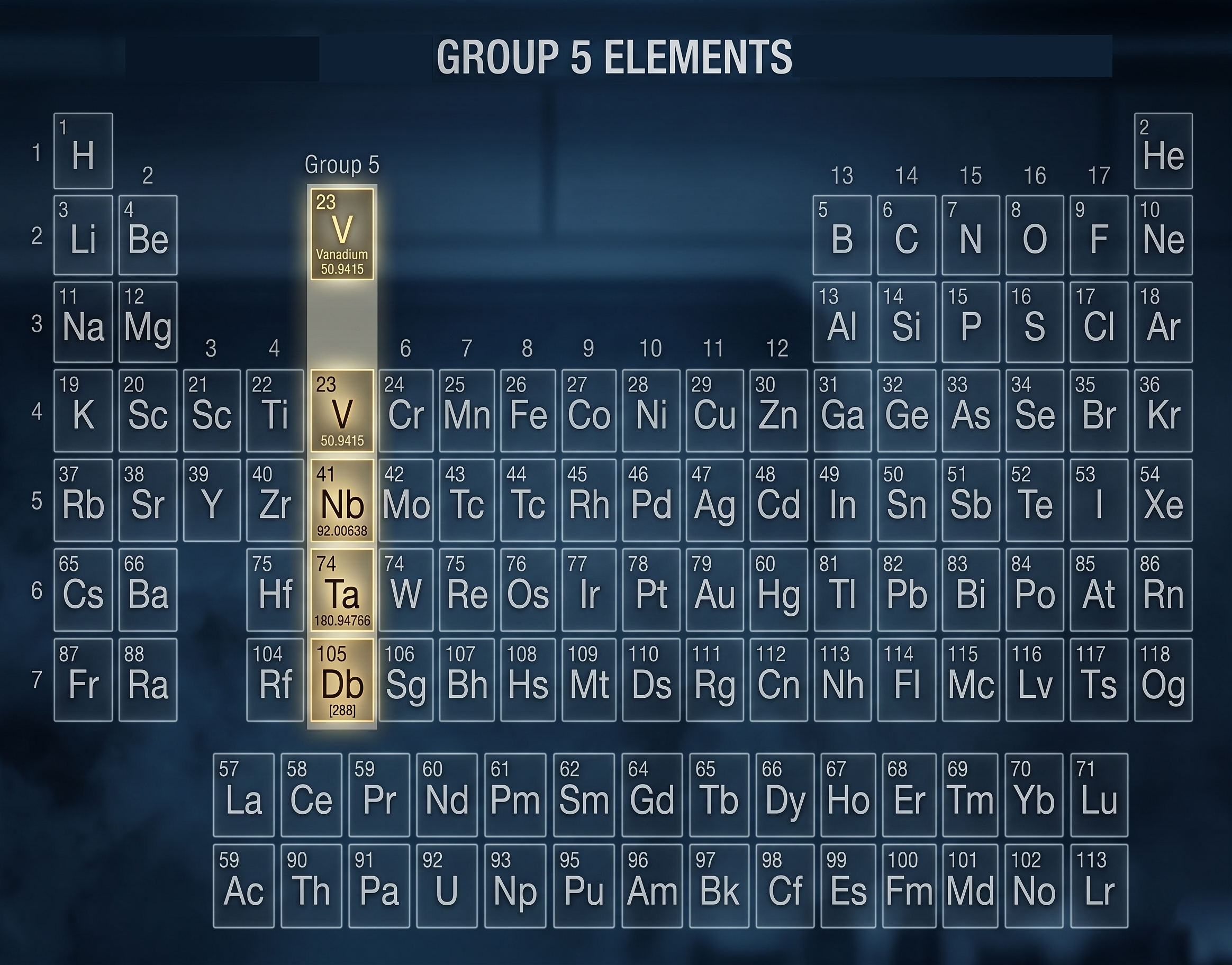
The Periodic Table isn’t just a chart – it’s a map of how materials behave. And tucked into Group 5 is a set of elements that quietly power some of the toughest, most demanding applications in modern technology.

This group includes vanadium, niobium, tantalum, and the lab-created dubnium. At first glance, they might seem similar – they sit in the same column, share electron structures, and behave like classic transition metals. But look closer, and each one plays a very different role.
From strengthening steel and enabling superconductors to powering electronics and pushing the limits of scientific discovery, Group 5 elements are built for extremes.
Key Highlights
- Group 5 includes vanadium (V), niobium (Nb), tantalum (Ta), and the synthetic element dubnium (Db)
- These elements share five valence electrons, leading to a dominant +5 oxidation state
- Vanadium, niobium, and tantalum are refractory metals with high heat and wear resistance
- Vanadium is unique for its biological role and multiple oxidation states
- Niobium and tantalum are critical in aerospace, superconductors, and electronics
- Dubnium exists only in laboratories and is used for advanced scientific research
What defines Group 5 elements?
Group 5 elements share a defining feature: five valence electrons arranged in their outer orbitals. This structure drives much of their chemistry, especially their tendency to form compounds in the +5 oxidation state.
Like many transition metals, they also form protective oxide layers when exposed to air. These layers act as a barrier against corrosion, making the metals stable even in harsh environments.
Another defining trait is their classification as refractory metals. Vanadium, niobium, and tantalum can withstand extremely high temperatures without losing strength, which makes them ideal for aerospace, industrial, and high-performance applications.
Shared trends across the group
As you move down Group 5, several patterns emerge:
- Melting points remain extremely high
- Atomic size increases, but niobium and tantalum are nearly identical due to lanthanide contraction
- Chemical reactivity is low at room temperature due to oxide passivation
- The +5 oxidation state becomes more stable
These shared trends explain why the elements behave similarly in some contexts – while still allowing for important differences in real-world applications.
Vanadium: Versatile and unexpected
Vanadium stands out as the most flexible element in the group.

It can exist in multiple oxidation states (+2 to +5), which allows it to form a wide range of compounds – many of them brightly coloured. This versatility makes it especially useful in chemical reactions and catalysis.
But what really sets vanadium apart is its biological role. It appears in certain enzymes and even in marine organisms, making it the only Group 5 element with a known function in living systems.
Where vanadium is used:
- Strengthening steel for construction, tools, and vehicles
- Aerospace alloys for high-temperature performance
- Industrial catalysts, especially in sulfuric acid production
South Africa is one of the world’s leading producers of vanadium, making it a strategically important material both locally and globally.
Niobium: Lightweight strength and superconductivity
Niobium brings a different advantage: strength without excessive weight.

It is the least dense of the refractory metals in Group 5, which makes it valuable in aerospace and structural applications. Even small amounts added to steel can dramatically improve strength and durability.
Niobium also has a high-tech side. When alloyed, it becomes superconductive at low temperatures, making it essential for MRI machines and particle accelerators.
Key uses of niobium:
- High-strength, low-alloy steels (pipelines, bridges, vehicles)
- Superconducting magnets for medical and research equipment
- Aerospace components requiring heat resistance and low weight
Tantalum: Built for corrosion and electronics
Tantalum is all about stability.
It is highly resistant to corrosion – so much so that it can withstand most acids. This makes it invaluable in chemical processing and extreme environments.
But its biggest impact is in electronics. Tantalum capacitors are small, reliable, and efficient, making them essential for smartphones, laptops, and other compact devices.
It’s also biocompatible, which allows it to be used safely in medical implants.

Common applications of tantalum:
- Electronic components (especially capacitors)
- Medical implants and surgical tools
- Chemical processing equipment
Dubnium: Science at the edge
Dubnium is a different kind of element altogether.
It doesn’t exist in nature and can only be created in particle accelerators – atom by atom. Its isotopes decay quickly, giving scientists only a short window to study them.

Because of this, dubnium has no industrial use. Its value lies entirely in research, helping scientists understand the behaviour of superheavy elements and the limits of the Periodic Table.
Natural occurrence and extraction
Vanadium, niobium, and tantalum are found in mineral deposits, often together, which makes extraction complex.
- Vanadium is commonly obtained from titaniferous magnetite ores
- Niobium is primarily extracted from pyrochlore
- Tantalum is sourced from coltan (columbite-tantalite)
Separating niobium and tantalum is particularly difficult due to their chemical similarity. Advanced techniques like solvent extraction are used to isolate them.
Dubnium, by contrast, is entirely synthetic and produced in extremely small quantities in laboratory settings.
Why Group 5 matters
Group 5 elements don’t get as much attention as some others – but they’re essential to modern life.
They strengthen the materials we build with, enable technologies we rely on, and support industries that operate under extreme conditions. From infrastructure and aerospace to electronics and medicine, their impact is everywhere.
And then there’s dubnium – reminding us that the Periodic Table isn’t finished. It’s still expanding, still being explored.
Understanding Group 5 isn’t just about memorising elements – it’s about seeing how chemistry shapes the technologies that define our world.
Ready to dive deeper into the D-block? – Watch our detailed video guide on the properties and uses of Group 5 elements.
Frequently asked questions
What makes Group 5 elements refractory metals?
Vanadium, niobium, and tantalum are classified as refractory metals because of their extremely high melting points, strength at high temperatures, and resistance to wear and corrosion.
What are common uses of Group 5 elements?
Vanadium strengthens steel, niobium is used in high-strength alloys and superconductors, and tantalum is widely used in electronics and medical implants.
Why is dubnium important if it has no practical uses?
Dubnium helps scientists study the behaviour of superheavy elements, improving our understanding of atomic structure and the limits of the Periodic Table.