
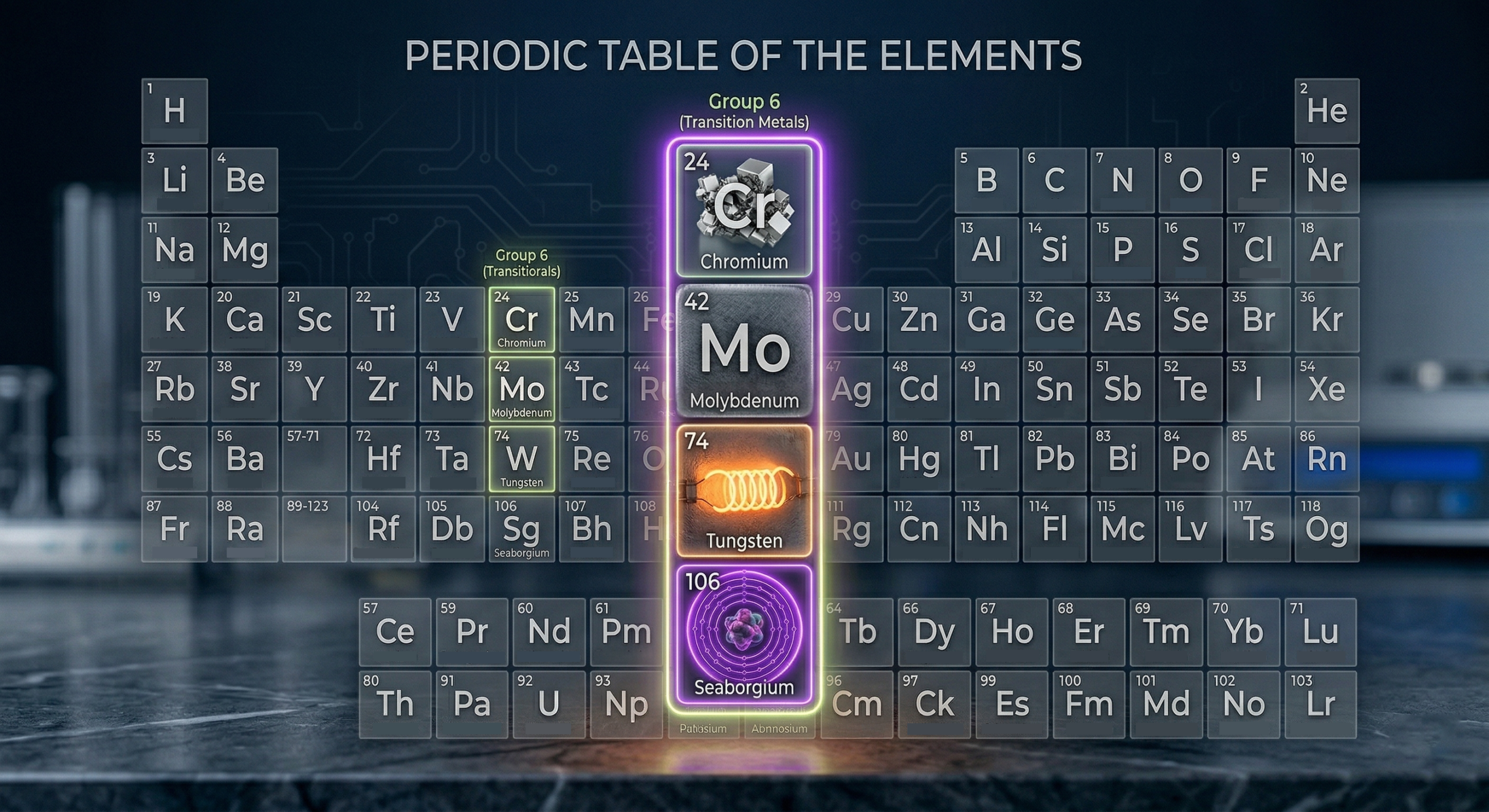
Some elements don’t just sit on the Periodic Table – they define entire industries. Group 6 is one of those cases.
This group includes chromium, molybdenum, tungsten, and the synthetic element seaborgium. Together, they represent some of the toughest, most heat-resistant materials known. From stainless steel and industrial catalysts to high-temperature alloys and advanced research, these elements are built for extremes.
What makes Group 6 especially interesting is how structure translates directly into function. Their electron configurations give them strength, stability, and chemical flexibility – qualities that show up in everything from construction materials to cutting-edge technology.
It’s one of the coolest ‘secrets’ in Chemistry: how tiny electrons can create massive physical strength. Watch the Doc Scientia video of Group 6, where we bridge the gap between microscopic atoms and the macro-strength of the world around us.
Key Highlights
- Group 6 includes chromium (Cr), molybdenum (Mo), tungsten (W), and the synthetic element seaborgium (Sg).
- These elements are transition metals known for strength, density, and extremely high melting points.
- They commonly exhibit multiple oxidation states, with +6 becoming more stable down the group.
- Chromium is essential for stainless steel and corrosion resistance.
- Molybdenum and tungsten are critical for high-temperature and high-strength applications.
- Seaborgium exists only in laboratories and is used for advanced scientific research.
What defines Group 6 elements?
Group 6 elements share a common electronic foundation: partially filled d-orbitals. This gives them the flexibility to form multiple oxidation states and participate in a wide range of chemical reactions.
One unusual feature of this group is its electron configuration. Chromium and molybdenum don’t follow the expected pattern – they adopt a more stable half-filled d-subshell. It’s a small detail, but it has a noticeable impact on their chemistry.
Another defining trait is their ability to form strong metallic bonds. This leads to exceptional hardness, high density, and resistance to heat – properties that make these elements indispensable in demanding environments.
Trends across the group
As you move down Group 6, several clear patterns emerge:
- Atomic size increases, though less dramatically than expected.
- Density rises significantly, with tungsten among the densest metals.
- Melting and boiling points increase sharply.
- The +6 oxidation state becomes more stable.
- Reactivity decreases slightly, especially for tungsten.
These trends help explain why tungsten dominates high-temperature applications, while chromium is more reactive and widely used in everyday materials.
Chromium: Corrosion resistance and strength
Chromium is the most familiar member of Group 6 – and one of the most widely used.

Its standout feature is corrosion resistance. When exposed to air, chromium forms a thin oxide layer that protects the metal beneath. This is what makes stainless steel resistant to rust.
Where chromium is used:
- Stainless steel production
- Chrome plating for durability and appearance
- Superalloys used in turbines and engines
South Africa plays a major role globally as one of the largest producers of chromium, making it a key material in the global steel industry.
Molybdenum: Strength at high temperatures
Molybdenum is less visible than chromium but just as important.

It improves the strength and heat resistance of steel, making it essential for pipelines, heavy machinery, and aerospace components. It also performs well under pressure and extreme temperatures.
Chemically, molybdenum is highly versatile, which makes it valuable as a catalyst – especially in petroleum refining, where it helps remove sulfur from fuels.
Key uses of molybdenum:
- High-strength steel alloys
- Catalysts in refining and chemical processing
- Emerging semiconductor materials (MoS₂)
It also plays a biological role as a trace element in enzymes, making it one of the few transition metals essential to life.
: Extreme heat, extreme performance
Tungsten is the heavyweight of the group.

It has the highest melting point of any metal, making it the go-to material for extreme heat applications. If something needs to survive thousands of degrees, tungsten is usually involved.
Common applications of tungsten:
- Heating elements and high-temperature furnaces
- Cutting tools and drill bits (as tungsten carbide)
- Aerospace and defence components
- Radiation shielding and counterweights
Its density and hardness also make it useful beyond temperature resistance – it’s one of the most durable materials available.
Seaborgium: Science at the limits
Seaborgium is entirely different from the rest of the group.

It doesn’t exist naturally and can only be created in particle accelerators. It is highly unstable, with a short half-life, which means it has no practical applications.
Instead, its importance lies in research. Studying seaborgium helps scientists understand how superheavy elements behave and how far the Periodic Table can extend.
Physical and chemical properties
Group 6 elements are defined by:
- High density and strength
- Extremely high melting and boiling points
- Strong metallic bonding
- Paramagnetic behaviour due to unpaired electrons
- Good (but not exceptional) electrical conductivity
Chemically, they are highly versatile. Their ability to adopt multiple oxidation states – especially +6 – allows them to form a wide range of compounds, from oxides to halides.
Important compounds and reactions
Group 6 elements form several industrially important compounds:
- Chromium oxides used in pigments and coatings.
- Molybdenum disulfide (MoS₂), a key lubricant and emerging semiconductor.
- Tungsten oxides used in catalysts and smart materials.
- Tungsten hexafluoride (WF₆), used in semiconductor manufacturing.
These compounds are central to industries ranging from construction to electronics.
Natural occurrence and extraction
These elements are not found in pure form and must be extracted from ores:
- Chromium → chromite
- Molybdenum → molybdenite
- Tungsten → wolframite and scheelite
Extraction typically involves converting ores into oxides, followed by reduction to pure metal.
South Africa dominates chromium production, while China leads in tungsten output. Molybdenum is often recovered as a byproduct of copper mining.
Industrial importance
Group 6 elements are essential to modern infrastructure and technology:
- Chromium enables corrosion-resistant steel.
- Molybdenum strengthens materials and supports clean fuel production.
- Tungsten enables high-temperature engineering and tooling.
Together, they support industries like construction, energy, aerospace, and manufacturing.
Biological role and safety
Chromium and molybdenum are essential trace elements in small amounts:
- Chromium supports glucose metabolism.
- Molybdenum helps enzymes process nutrients.
However, form matters. While dietary chromium (Cr³⁺) is safe, industrial hexavalent chromium (Cr⁶⁺) is toxic and carcinogenic.
Exposure risks are mainly industrial, with strict safety controls required.
Why Group 6 matters
Group 6 elements are the backbone of materials that need to perform under pressure – literally.
They make steel stronger, engines more durable, electronics more advanced, and industrial processes more efficient. Even seaborgium, with no practical use, expands our understanding of atomic structure.
Taken together, this group shows how the Periodic Table isn’t just theoretical – it’s deeply practical. It shapes the materials we rely on every day and the technologies that define the future.
Frequently asked questions
Why are Group 6 elements considered transition metals?
Because they have partially filled d-orbitals, allowing them to form multiple oxidation states and complex compounds.
What are common uses of Group 6 elements?
Chromium is used in stainless steel, molybdenum in alloys and catalysts, and tungsten in high-temperature applications and cutting tools.
Why is tungsten so important?
It has the highest melting point of any metal, making it essential for extreme heat environments.
Does seaborgium have any real-world uses?
No. It is used only in scientific research to study superheavy elements.