
Some elements are valuable because they’re useful. Others because they’re rare.
Group 11 elements manage to be both – and that’s exactly why humans have been drawn to them for thousands of years.
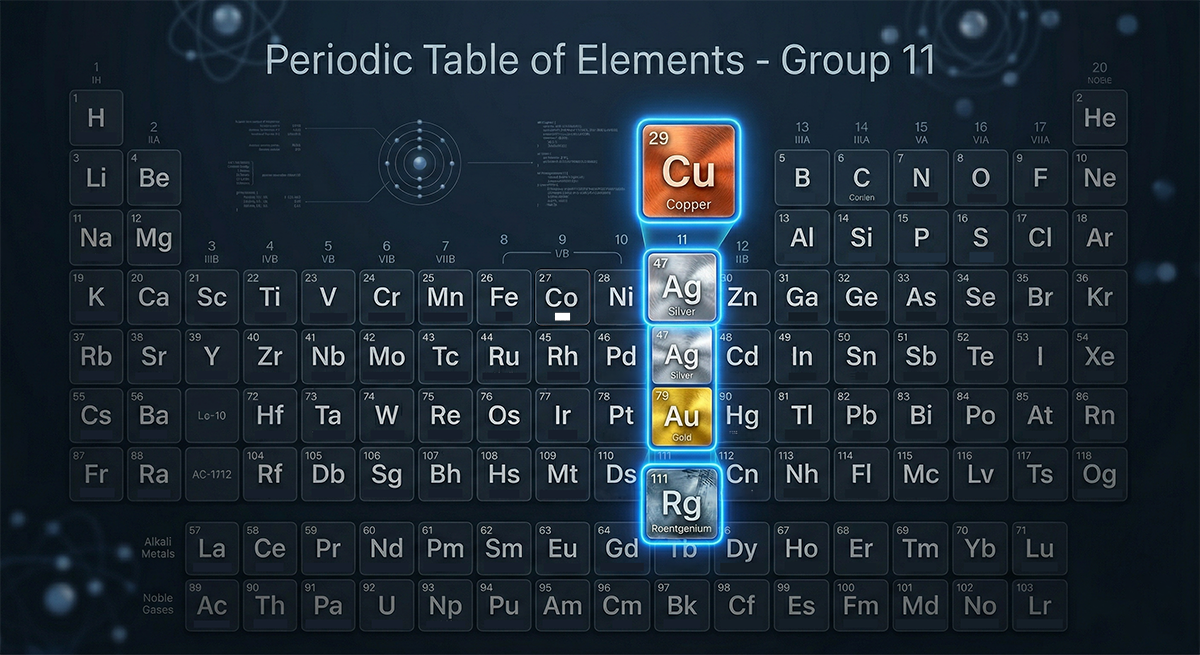
This group includes copper, silver, gold, and roentgenium. Often called the coinage metals, they’ve shaped economies, technologies, and cultures in ways few other elements have. From ancient coins and jewellery to modern electronics and renewable energy systems, their influence runs deep.
Long before they were used in electronics or jewellery, the elements of Group 11 were shaping human history. But what is the science behind their fame? Watch ‘The Atomic Blueprint,’ where we go under the surface to see how the unique structure of Copper, Silver, and Gold makes them the ultimate conductors.
What makes them especially interesting is their balance of beauty and performance. These aren’t just attractive metals – they’re among the best conductors of electricity and heat, which makes them just as important in engineering as they are in art.
What defines Group 11 elements?
At the atomic level, Group 11 elements share a similar structure: a single electron in their outermost shell, sitting above a filled set of inner d-orbitals.
That arrangement turns out to be incredibly useful. It gives these metals high electrical and thermal conductivity, while also keeping them relatively stable and less reactive than most transition metals.
They typically form a +1 oxidation state, although copper and gold can go further under the right conditions. But overall, they don’t react aggressively with their surroundings – and that’s part of their appeal.
It’s why gold can sit unchanged for centuries, and why copper wiring can last for decades.
A group shaped by subtle trends
As you move down Group 11, the changes are steady but meaningful.
Atoms become larger and heavier, density increases, and resistance to corrosion improves. Reactivity generally decreases, reaching its lowest point with gold, one of the least reactive metals known.
These aren’t dramatic shifts – but they matter. They explain why copper is widely used in infrastructure, while gold is reserved for applications where stability is critical.
Copper: The metal that built the modern world
Copper is where practicality meets performance.
It’s been used by humans for over 10,000 years, and it’s still one of the most important industrial metals today. The reason is simple: it conducts electricity extremely well, it’s durable, and it’s relatively abundant.

That combination makes it the backbone of modern infrastructure. Electrical wiring, power grids, electronics, plumbing systems – copper runs through all of it.
Over time, it reacts slowly with air to form a green surface layer known as a patina. Rather than damaging the metal, this layer actually protects it from further corrosion.
It’s one of those rare materials that improves with age.
Silver: Unmatched conductivity
If copper is excellent, silver is exceptional.
It’s the best conductor of electricity of any element. It also reflects light extremely well and transfers heat efficiently. On a purely performance level, silver outperforms every other metal in its group.

So why isn’t everything made of silver?
Cost.
Because it’s more expensive, silver is used selectively – mainly in high-performance electronics, solar panels, and specialized coatings. It also appears in jewellery and decorative items, continuing its long association with wealth and craftsmanship.
Silver does tarnish over time, reacting with sulfur in the air. But this is only a surface effect and doesn’t impact its conductivity.
Gold: Stability above all
Gold takes a different path.
Where copper and silver balance performance and cost, gold leans fully into stability. It is incredibly unreactive – it doesn’t tarnish, corrode, or degrade under normal conditions.

That’s why gold artifacts can survive for thousands of years without losing their shine.
But gold isn’t just for decoration. Its reliability makes it essential in electronics, especially in connectors and circuits where failure isn’t an option. It’s also used in aerospace, medicine, and precision equipment.
Another defining trait is its malleability. Gold can be stretched and shaped to an extreme degree without breaking, making it one of the most workable metals known.
Roentgenium: The theoretical member
At the bottom of the group sits roentgenium, element 111.
Unlike the others, it doesn’t exist naturally. It’s created in particle accelerators and survives for only fractions of a second before decaying.

Because of this, its properties are mostly predicted. Scientists expect it to behave similarly to gold, but direct observation is extremely limited.
For now, roentgenium is less about application and more about expanding our understanding of atomic structure.
Physical properties: Built for performance
Group 11 metals share a set of physical traits that explain their long-standing importance.
They conduct electricity and heat extremely well, which is why they’re central to power systems and electronics. They’re also malleable and ductile, meaning they can be shaped, stretched, and formed without breaking.
Their characteristic metallic lustre has made them desirable for decorative use, while their density – especially in gold – adds to their durability and value.
These properties don’t just make them useful. They make them reliable.
Chemical behaviour and reactivity
Compared to other transition metals, Group 11 elements are relatively unreactive.
Copper reacts slowly with oxygen, forming its familiar green coating over time. Silver reacts with sulfur compounds, leading to tarnish. Gold, however, barely reacts at all – it resists almost everything except highly aggressive chemical mixtures like aqua regia.
This low reactivity is a major advantage. It allows these metals to maintain their properties over long periods, even in challenging environments.
Where these elements are found
In nature, these metals appear in different forms.
Copper is widely distributed in ores and mined on a large scale. Silver is found both in ores and in its native metallic form. Gold is famous for occurring naturally in pure form, often in rivers or embedded in rock.
Roentgenium, by contrast, doesn’t occur in nature at all.
The availability of copper makes it suitable for widespread use, while the rarity of silver and gold contributes to their value.
Why Group 11 matters
Group 11 elements have never really gone out of relevance – they’ve just adapted.
They started as materials for coins and ornaments, symbols of wealth and power. Today, they sit at the heart of electrical systems, renewable energy technologies, and advanced electronics.
Copper keeps the world connected. Silver pushes performance further. Gold ensures reliability where it matters most.
Together, they show how a single group in the Periodic Table can bridge ancient history and modern innovation – without losing its importance along the way.
Frequently asked questions
What elements are in Group 11?
Copper, silver, gold, and roentgenium.
Why are they called coinage metals?
Because copper, silver, and gold have historically been used to make coins.
Which is the best conductor?
Silver conducts electricity better than any other element.
Why doesn’t gold tarnish?
Because it is extremely unreactive and does not easily form compounds with oxygen or other substances.