
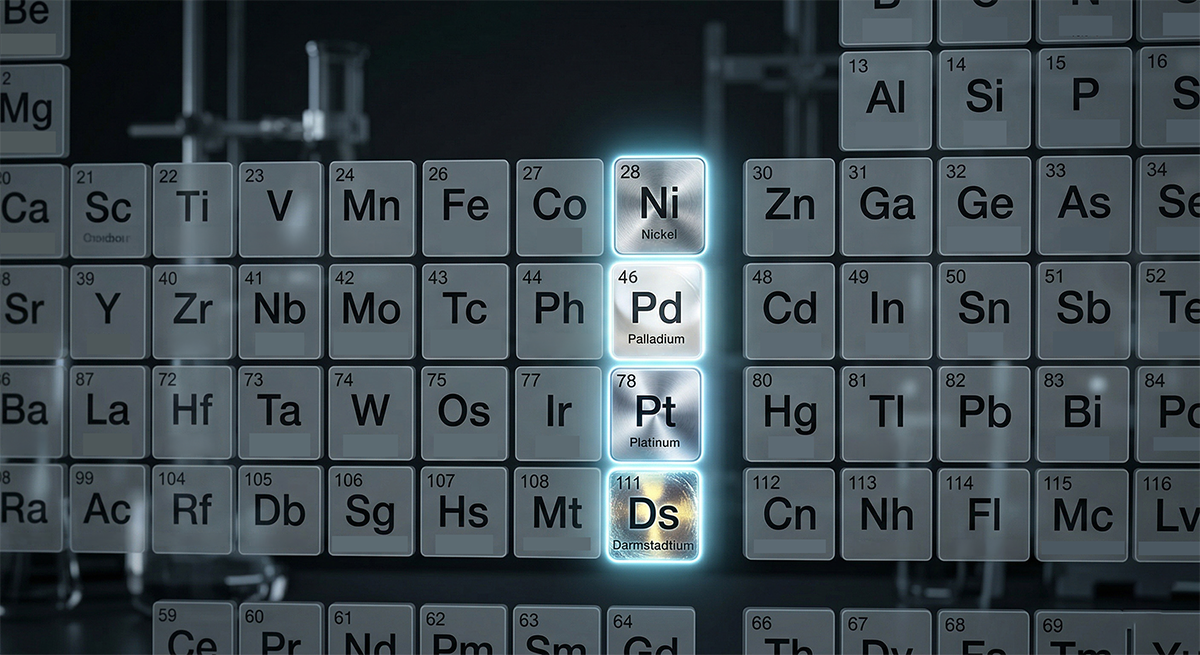
Some elements are valuable because they’re strong. Others because they’re rare.
Group 10 elements are both.
This group – nickel, palladium, platinum, and darmstadtium – sits at the centre of the transition metals and plays a major role in modern industry. From stainless steel and rechargeable batteries to catalytic converters and cancer treatments, these elements are woven into everyday life in ways that often go unnoticed.
What makes Group 10 especially interesting is its balance. Nickel is relatively abundant and widely used, while palladium and platinum are rare and highly specialized. Darmstadtium, at the far end, exists only in laboratories.
Together, they show how the Periodic Table moves from practical materials to cutting-edge science.
Key highlights
- Group 10 includes nickel (Ni), palladium (Pd), platinum (Pt), and darmstadtium (Ds).
- These are transition metals with partially filled d-orbitals.
- They are known for high melting points, durability, and resistance to corrosion.
- Palladium and platinum belong to the platinum group metals (PGMs).
- They commonly exhibit +2 oxidation states, with higher states more stable down the group.
- These elements are widely used in catalysis, electronics, medicine, and manufacturing.
What defines Group 10 elements?
Group 10 elements are defined by their electron configuration and position in the d-block.
Their partially filled d-orbitals give them several important characteristics:
- Multiple oxidation states
- Strong metallic bonding
- High catalytic activity
- Ability to form complex compounds
This is why they are so effective in industrial chemistry. They don’t just participate in reactions – they help control and accelerate them.
Another defining trait is stability. As you move from nickel to platinum, the metals become less reactive and more resistant to corrosion. This makes the heavier elements especially valuable in harsh environments.
Trends across the group
Group 10 follows clear periodic trends:
- Atomic size and mass increase down the group.
- Density increases significantly (platinum is extremely dense).
- Melting and boiling points increase.
- Reactivity decreases.
- Resistance to oxidation and corrosion increases.
- Higher oxidation states become more stable.
Nickel is the most reactive and commonly used, while platinum is one of the most chemically stable metals known.
Nickel: Versatile and essential
Nickel is the most abundant and widely used Group 10 element.
It’s a silvery-white metal known for its strength, corrosion resistance, and magnetic properties. Unlike palladium and platinum, nickel is used on a massive industrial scale.

Common uses of nickel:
- Stainless steel production
- Rechargeable batteries (including EV batteries)
- Electroplating for corrosion protection
- Alloys for aerospace and engineering
- Coins and everyday metal products
Nickel is also ferromagnetic, making it useful in magnets and electronic components.
Biologically, it plays a small but important role, and in humans it is indirectly essential through its presence in trace systems.
Palladium: Catalytic and efficient
Palladium is rarer than nickel but extremely important in modern technology.
Its standout feature is its ability to act as a catalyst – speeding up chemical reactions without being consumed.

Key applications of palladium:
- Catalytic converters in vehicles
- Electronics (capacitors and connectors)
- Hydrogen storage and purification
- Jewellery (often alloyed into white gold)
One of its most unusual properties is its ability to absorb large amounts of hydrogen – up to hundreds of times its own volume. This makes it important for clean energy research.
Palladium is also central to organic chemistry, especially in reactions used to build pharmaceuticals and advanced materials.
Platinum: stability and prestige
Platinum is one of the most stable and valuable metals in the world.

It resists corrosion, does not tarnish, and remains stable even at high temperatures. This makes it ideal for both luxury and high-performance applications.
Where platinum is used:
- Fine jewellery
- Catalytic converters
- Fuel cells for clean energy
- Laboratory equipment
- Cancer treatment drugs (e.g., cisplatin)
Platinum’s role in medicine is especially important. Its compounds are widely used in chemotherapy, making it one of the most medically significant metals.
It also plays a key role in the transition to greener technologies, particularly hydrogen fuel cells.
Darmstadtium: At the edge of the Periodic Table
Darmstadtium is a synthetic element with atomic number 110.

It does not occur naturally and is created in particle accelerators. Only a few atoms have ever been produced, and they exist for fractions of a second before decaying.
Because of this:
- It has no practical applications.
- Its properties are mostly predicted.
- It is used only in scientific research.
Scientists believe it behaves similarly to platinum, but its extreme instability makes experimental confirmation difficult.
Physical properties of Group 10 elements
These elements share strong metallic characteristics:
- High density (especially platinum)
- High melting and boiling points
- Lustrous, silvery appearance
- Good electrical and thermal conductivity
- Resistance to wear and corrosion
Nickel is magnetic, while palladium and platinum are not strongly magnetic.
Their durability and resistance to environmental damage make them ideal for long-term use in industrial and technological systems.
Chemical properties and reactivity
Group 10 elements are relatively unreactive compared to many other metals.
- Nickel reacts slowly with acids.
- Palladium is more resistant but still reactive under strong conditions.
- Platinum is highly inert and resists most chemical attack.
Their ability to adopt multiple oxidation states – especially +2 and +4 – makes them chemically versatile.
They also form complex compounds, particularly in coordination and organometallic chemistry, where metal–ligand interactions are key.
Catalysis and chemical importance
One of the most important roles of Group 10 elements is catalysis.
They are used to speed up chemical reactions in:
- Industrial manufacturing
- Environmental protection (catalytic converters)
- Pharmaceutical synthesis
- Fuel production
Palladium and platinum are especially effective catalysts because they can easily switch between oxidation states and bind with different molecules.
This flexibility allows them to drive reactions efficiently and selectively.
Natural occurrence and extraction
The availability of Group 10 elements varies widely:
- Nickel is relatively abundant and found in ores with iron, copper, and sulfur.
- Palladium and platinum are rare and found with platinum group metals.
- Darmstadtium does not occur naturally.
Major sources include:
- South Africa (largest platinum group metal reserves)
- Russia (significant palladium production)
- Canada (nickel deposits)
- United States (notable palladium sources)
Extraction involves complex processes such as smelting, refining, and chemical separation.
Industrial importance
Group 10 elements are essential across multiple industries:
- Nickel supports construction, transportation, and energy storage.
- Palladium reduces vehicle emissions and supports electronics.
- Platinum enables medical treatments and clean energy technologies.
Their value lies not just in what they are – but in what they enable.
Without them, many modern technologies would be far less efficient – or impossible.
Biological role and safety
Nickel has limited biological relevance and is present in trace amounts, though excessive exposure can cause allergic reactions.
Palladium and platinum have no essential biological role, but their compounds can be used in medicine.
Safety considerations include:
- Nickel allergies in skin contact
- Toxicity of certain metal compounds
- Occupational exposure in industrial settings
Proper handling ensures these elements remain beneficial rather than harmful.
Why Group 10 matters
Group 10 elements quietly power some of the most important systems in modern life.
They strengthen the materials we build with, clean the air we breathe, enable life-saving medicines, and drive chemical reactions that sustain entire industries.
From nickel in everyday steel to platinum in advanced medical treatments, this group shows how chemistry scales – from the ordinary to the extraordinary.
Frequently asked questions
What elements are in Group 10?
Nickel, palladium, platinum, and darmstadtium.
Why are Group 10 elements important?
They are widely used in catalysis, electronics, medicine, and industrial processes.
Which Group 10 element is most commonly used?
Nickel, due to its abundance and role in stainless steel and batteries.
Do all Group 10 elements occur naturally?
No. Darmstadtium is synthetic and exists only in laboratories.