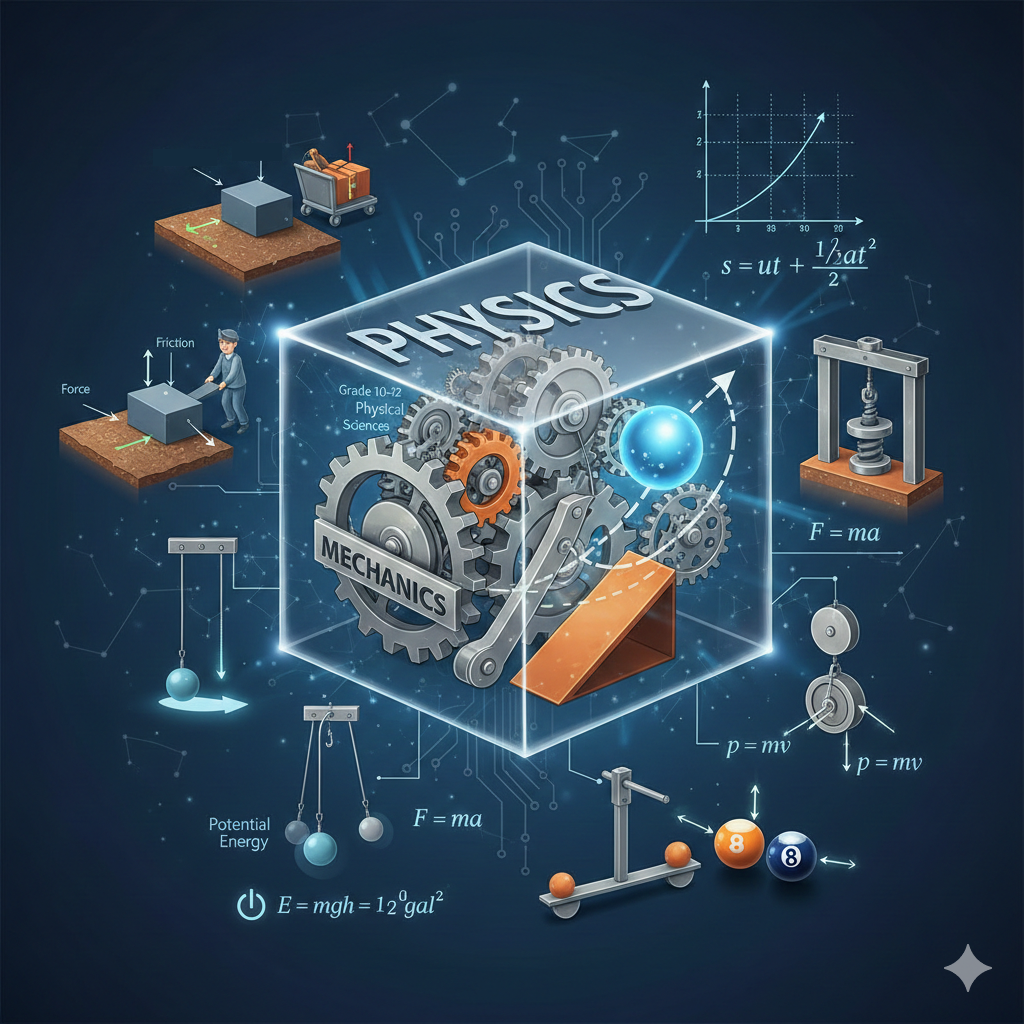
This guide provides a detailed look at the Physics CAPS curriculum for South African learners in Grade 10 – 12.
The Further Education and Training (FET) phase, starting in Grade 10, marks a significant step up in your academic journey.
Physical Sciences is a key elective subject that opens doors to many future career paths.
Success in your final years depends on using resources like past exam papers and memos for effective revision.
The curriculum builds foundational knowledge toward the National Senior Certificate.
Introduction
Welcome to your guide for navigating the Physical Sciences curriculum in South Africa! If you’re a Grade 10 or 11 learner, you know that these years are crucial for building a strong academic foundation. Physical Sciences, especially Physics, can be challenging but also incredibly rewarding. This guide is here to help you understand the CAPS framework, what you’ll be learning, and how you can use available resources to succeed. Let’s get you prepared for a future of exciting possibilities.
Overview of Physics CAPS curriculum for Grade 10 and Grade 11 in South Africa
The Curriculum and Assessment Policy Statement (CAPS) provides a structured framework for all subjects, including Physical Sciences. For learners in South Africa, this means your educational path is clearly defined, ensuring you gain the necessary skills and knowledge each year. The curriculum is designed to build on itself, with each grade preparing you for the next level of complexity.
Understanding this structure is your first step toward success. As you move from Grade 10 to Grade 11 and finally Grade 12, the topics become more advanced, requiring greater dedication. Knowing what to expect from CAPS exam papers, especially for Physics, and how the content progresses will help you plan your studies and feel more confident.
Structure and key outcomes of the CAPS system
The CAPS system for the FET phase (Grades 10-12) is designed to give you a well-rounded education while allowing for specialisation. Grade 10 is the starting point where you focus on seven subjects. This structure requires you to balance compulsory subjects with electives that match your interests and career goals. The goal is to develop critical thinking and problem-solving skills, which are essential for your final exams.
A key outcome is to prepare you for the end-of-year exam papers, which test your understanding of the entire year’s work. The system encourages consistent effort, with assessments spread throughout the term. For learners, this means staying on top of your workload is vital.
Your subject choices in Grade 10 are a mix of required and elective courses. Here is a typical breakdown:
Compulsory Subjects
Elective Subjects (Choose 3)
English Home Language
Physical Sciences
First Additional Language
Life Sciences
Mathematics or Mathematical Literacy
Geography & History
Life Orientation
Business Studies, Accounting, Economics
Physics – Grade 10, Grade 11, and Grade 12 curricula
The CAPS-aligned core knowledge areas for Physics (Paper 1 of Physical Sciences) follow a logical progression, moving from foundational definitions and descriptive concepts in Grade 10 to advanced laws, calculations, and modern applications in Grade 12.
Here is a breakdown of the key differences and the progression of topics:
Grade 10: Introduction and foundations
Grade 10 focuses on the basic concepts, definitions, and qualitative descriptions of all four main physics knowledge areas, establishing the necessary vocabulary and observational skills.
Knowledge Area
Grade 10 Focus (Foundational/Descriptive)
Mechanics
Motion in One Dimension (1D): Basic definitions of position, distance, displacement, speed, velocity, and acceleration. No complex force problems.
Scalars and Vectors: Introduction to the difference between them.
Energy: Introduction to Gravitational Potential Energy and Kinetic Energy.
The Atom: Basic atomic structure and charge.
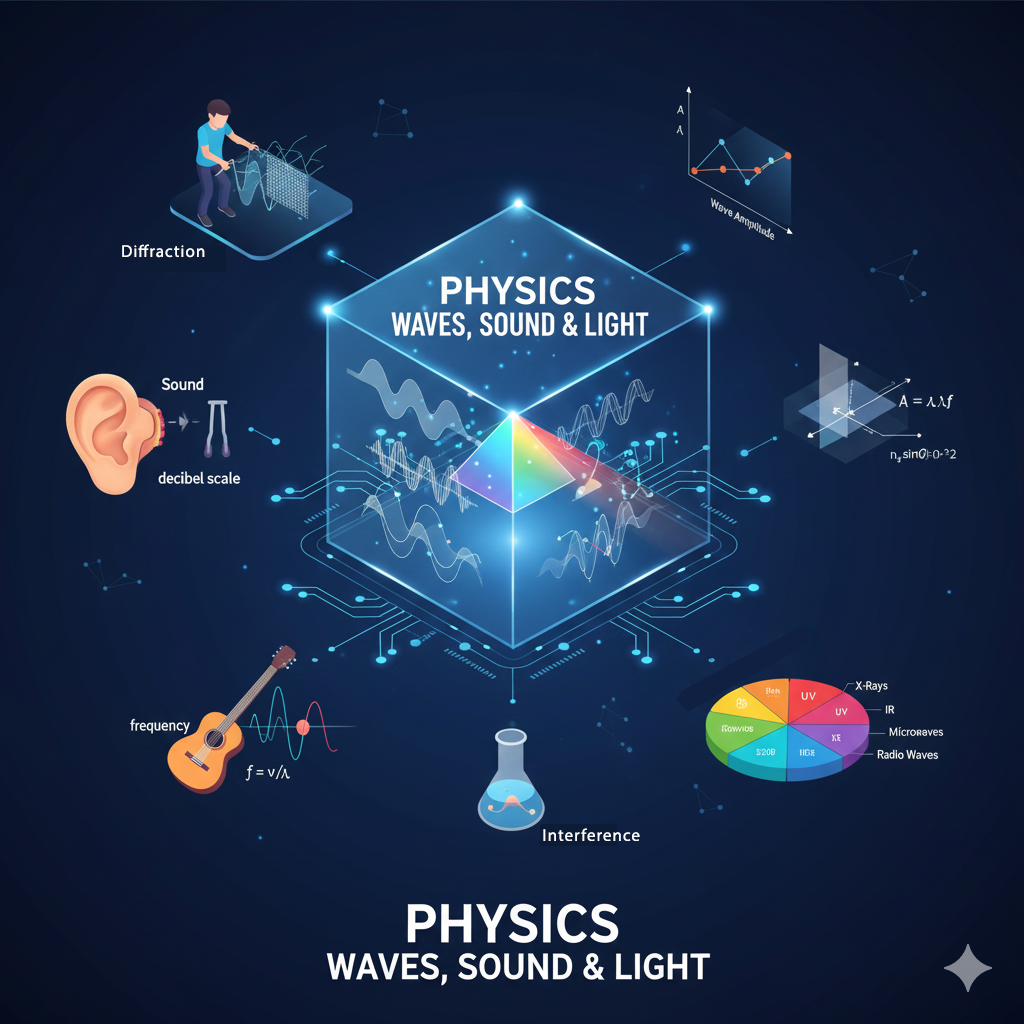
Waves, Sound & Light
Transverse and Longitudinal Waves: Definitions of basic concepts like pulse, amplitude, wavelength, frequency, and period.
Sound: Describing sound as a longitudinal wave and relating pitch/loudness to frequency/amplitude.
Electromagnetic Radiation: The electromagnetic spectrum and calculating photon energy.
Electricity & Magnetism
Basic concepts of charge, conservation of charge, quantisation of charge and charging by friction.
Electric Circuits: Basic definitions of potential difference, current, resistance, and calculating total resistance in simple series and parallel circuits.
Grade 11: Laws and quantitative application
Grade 11 transitions from descriptions to laws, diagrams, and quantitative problem-solving in Mechanics and Electricity, introducing vector analysis in two dimensions.
Knowledge Area
Grade 11 Focus (Laws/Quantitative Application)
Mechanics
Vectors in 2D: Resolving vectors into components, and graphical vector addition (tail-to-head method).
Newton’s Laws of Motion: First, Second, and Third Laws. Application to complex systems (e.g., objects on slopes, friction, and two-body systems using free-body diagrams).
Newton’s Law of Universal Gravitation: Calculating the gravitational force between two objects.
Waves, Sound & Light
Waves: Review of Grade 10 concepts.
Electricity & Magnetism
Electrostatics: Moving from simple charge to
Electric Field concepts (field lines and calculating electric field strength.
Electric Circuits: Deeper application of Ohm’s Law and power/energy calculations.
Electromagnetism: Introduction to the magnetic field around current-carrying conductors, and the operation of simple DC Motors.
Grade 12: Momentum, Energy, and Modern Physics
Grade 12 focuses on deepening the understanding of Mechanics principles through conservation laws, applying advanced concepts to real-world phenomena (like the Doppler Effect), and introducing Modern Physics.
Momentum and Impulse: Definition, Principle of Conservation of Linear Momentum, and calculating impulse.
Vertical Projectile Motion (1D): Analysis using motion graphs and equations, focusing on objects under gravity alone.
Work, Energy, and Power: Work-Energy Theorem and Principle of Conservation of Mechanical Energy (including non-conservative forces like friction).
Waves, Sound & Light
The Doppler Effect: Definition and application to sound, explaining pitch change due to relative motion.
Electricity & Magnetism
Electric Circuits: Advanced circuit analysis, including the effects of Internal Resistance in a battery, and Terminal Potential Difference.
Electrodynamics: Principles of Electromagnetic Induction (Faraday’s Law), the operation of Generators (AC and DC) and the concept of RMS values in AC Circuits.
Matter & Materials| Photo-electric Effect
Introducing the quantum nature of light (photons) and the concept of work function.
Emission and Absorption Spectra: Using spectral lines as evidence for energy levels in atoms.
Summary of Progression
The progression can be summarised as:
Grade 10:Defining and describing the basic properties of motion, waves, charge, and circuits.
Grade 11:Applying fundamental laws (Newton’s Laws, Universal Gravitation, Electric Field) and introducing vector resolution to solve more challenging, quantitative problems.
Grade 12:Applying conservation principles (Momentum, Mechanical Energy) to complex dynamic systems, exploring electromagnetic induction, and introducing the concepts of Modern Physics.
Required textbooks and study materials
Having the right study materials is essential for mastering Physical Sciences. Your school will provide a list of prescribed textbooks that are aligned with the CAPS curriculum. These books are your primary resource, as they cover all the topics in the required depth and prepare you for what to expect in assessments. You can often find downloadable lists in PDF format to ensure you have the correct editions.
Beyond textbooks, a wealth of supplementary materials can aid your revision. It’s a good idea to collect past CAPS exam papers and their corresponding memos. Working through these helps you get familiar with the exam format and the types of questions you will be asked.
In conclusion, the Physics CAPS curriculum for Grade 10 ,11 and 12 is designed to equip learners with a solid foundation in Physical Sciences. By understanding the structure, core topics, and available resources, learners can navigate their studies more effectively. Utilising recommended textbooks, online platforms, and past exam papers will enhance preparation and boost confidence. Remember, staying organised and proactive in your studies can lead to success in mastering Physics concepts. If you have any questions or need further assistance, feel free to reach out, and let’s make this academic journey a rewarding experience together!
Frequently Asked Questions
Can I access past National Senior Certificate exam papers for Grade 10 and Grade 11?
While the National Senior Certificate (NSC) is a Grade 12 qualification, learners can find past provincial or school-based exam papers for Grade 10 and 11. These are excellent for practice and are often available online in PDF format with memos, helping you prepare for the format of the final NSC exams.
What strategies help prepare effectively for Grade 10 Physical Sciences exams?
Effective preparation involves creating a study schedule, practicing daily revision, and working through past exam papers and testpapers. Don’t hesitate to ask tutors for help with difficult topics. This disciplined approach applies to all subjects, from Physical Sciences to Business Studies, and is key to achieving good results.
Here is a quick look at what you need to know about the CAPS Chemistry curriculum for your final high school years:
Chemistry is part of the Physical Sciences, which is a key elective for many university degrees.
The curriculum builds from Grade 10 to 12, so a strong foundation is crucial for success.
You must take four compulsory subjects alongside three electives like Physical Sciences, Life Sciences, or Geography.
Your performance in these years contributes toward your final National Senior Certificate.
Using study resources like past exam papers is essential for effective revision.
Introduction
Welcome to the final phase of your high school journey in South Africa! Grade 10 marks the beginning of the FET phase, a big step up from Grade 9 that requires more focus and dedication. Understanding the CAPS curriculum for subjects like Chemistry, which falls under Physical Sciences, is your first step toward success. This guide will walk you as learners through the curriculum for Grades 10, 11, and 12, helping you navigate your studies and prepare for the future.
Overview of the CAPS curriculum for Grade 10, 11, and 12 Chemistry
The CAPS curriculum for the final three years of high school is designed to give you a well-rounded education. As learners, you will take four compulsory subjects and choose three electives from a list that includes Physical Sciences, Business Studies, and others. This structure allows you to build core skills while exploring areas that match your career goals.
Your choices and performance in these grades are vital, as they all build toward your National Senior Certificate. Chemistry, as a component of Physical Sciences, is a demanding but rewarding subject that opens doors to many exciting fields. Let’s explore its structure and what to expect.
Structure and objectives of the CAPS Physical Sciences syllabus
The structure of the FET phase curriculum is straightforward. It ensures you gain essential knowledge through compulsory subjects while specialising through your electives. Physical Sciences is one of these crucial electives, particularly if you are interested in science, engineering, or health-related careers. The objective is to build a deep understanding of the physical world.
This subject aims to develop your critical thinking, problem-solving, and analytical skills. You will learn to apply scientific principles to real-world scenarios, preparing you not just for exams but for higher education and beyond. A solid grasp of the foundational concepts introduced in Grade 10 is essential for succeeding in later years.
The subject combination in the FET phase is structured as follows:
Subject Type
Description
Compulsory Subjects
You must take four required subjects: Home Language, First Additional Language, Mathematics or Mathematical Literacy, and Life Orientation.
Elective Subjects
You must choose three additional subjects. Options include Physical Sciences, Life Sciences, History, and more.
Key curriculum changes and updates in South Africa
The education system in South Africa is always evolving to better meet the needs of learners and the modern world. Staying aware of these curriculum updates helps you prepare more effectively for your assessments and future career. The Department of Basic Education regularly reviews the curriculum to ensure it remains relevant.
A major trend is the increased focus on developing skills for the 21st century. This means you will see more emphasis on critical thinking and problem-solving across all subjects, not just memorising facts. The goal is to equip you with the abilities needed to succeed in a rapidly changing global economy.
Here are some recent trends in the South African curriculum:
Digital Literacy: A greater push for technology-related subjects to prepare you for the digital age.
Critical Thinking: More focus on developing problem-solving skills rather than just rote learning, which is reflected in how exam papers are set.
Curriculum Relevance: Regular updates ensure the content you learn is current and effective for your revision and studies.
Core Topics in Grade 10, 11, and 12 Chemistry
The Chemistry curriculum within Physical Sciences is designed to be progressive. It starts with foundational knowledge in Grade 10 and builds in complexity through Grades 11 and 12. This approach ensures you develop a thorough and deep understanding of the subject by the time you write your final exam papers.
Unlike subjects such as Business Studies, the concepts in Chemistry are highly interconnected. Mastering one topic is often a prerequisite for understanding the next. This makes consistent effort and revision, often supported by studying past papers and memos, essential for keeping up and achieving great results. Let’s look at the themes and concepts covered each year.
Important themes and concepts covered each year
Each year of your FET studies in Chemistry focuses on different levels of understanding, starting with the basics and moving toward complex applications. Grade 10 is all about laying a solid foundation. Here, you are introduced to the fundamental principles that govern the world of matter and chemical change.
As you advance to Grade 11, the curriculum encourages you to apply these foundational concepts to more complex problems. Grade 12 then consolidates all your knowledge, preparing you for the final exams and the challenges of university-level science. This structure is common across many subjects, from Physical Sciences to Life Sciences and Geography.
The progression of learning can be summarised as follows:
Grade 10: Focuses on foundational concepts, including the classification of matter, the Periodic Table, and basic chemical bonding.
Grade 11: Builds on Grade 10 topics with a deeper look at stoichiometry, intermolecular forces, and energy changes in reactions.
Grade 12: Centers on advanced topics like reaction rates, chemical equilibrium, electrochemistry, and organic chemistry, integrating all previous learning.
Comparison of Grade 10, 11, and 12 Chemistry content
Comparing the Chemistry content across Grades 10, 11, and 12 reveals a clear path of increasing complexity. While your elective subject choices for high school are made in Grade 9, the content within a subject like Physical Sciences evolves significantly each year. Grade 10 introduces you to the language of Chemistry.
Grade 11 takes this language and starts building more complex “sentences,” requiring you to connect multiple ideas. By Grade 12, you are expected to write “essays,” integrating various concepts to solve multi-step problems. This progression is designed to build your confidence and competence steadily.
Here’s a comparison of the focus for each grade level:
Grade Level
Content Focus
Key Objective
Grade 10
Foundational Knowledge
Introduce core concepts and basic principles of Chemistry.
Grade 11
Application and Interconnection
Apply foundational knowledge to more complex scenarios and link different topics.
Grade 12
Consolidation and Mastery
Master advanced topics and integrate all learned concepts for final exams.
Study resources and exam preparation for Chemistry
Excelling in Chemistry requires consistent effort and the right study materials. Simply attending class is not enough; effective revision is key to mastering the content. Luckily, there are many resources available to help learners like you prepare for tests and exam papers.
From materials provided by the Department of Education to the support of tutors and digital tools, you can build a strong study plan. The goal is to find what works best for your learning style and use it to identify and strengthen any weak areas before exam time. Below, we explore some of the best resources available.
Using past papers and Department of Education materials
One of the most effective revision techniques is working with past exam papers. These testpapers give you a real feel for the format of the questions, the time pressure of the exam, and the topics that are most frequently assessed. It’s an active way to study that is far more engaging than just rereading your notes.
The Department of Education website is an excellent place to find these resources. They often provide access to past National and Provincial exam papers and their marking guidelines for free. This allows you to practice questions and immediately check your answers, which is a powerful way to learn from your mistakes.
Here’s how to make the most of these materials:
Download papers directly from the Department of Education website or other educational resource portals.
Simulate exam conditions by timing yourself as you complete a paper.
Analyse the marking guidelines to understand how marks are awarded.
Use your results to identify knowledge gaps and focus your revision on those areas.
Recommended online learning materials for Chemistry
In today’s digital world, learners have access to an incredible range of study tools right at their fingertips. Digital platforms, educational apps, and online study guides can make your revision more interactive and engaging. Many of these resources are designed to help you visualise complex chemical processes, which can be a huge help.
Here are quick links to Doc Scientia’s video lessons for Grade 11 & 12 Chemistry:
How assessments work in Grade 10, 11, and 12 Chemistry
Assessments in Chemistry are a mix of tasks, tests, and exams spread throughout the year. This system of continuous assessment ensures that your final mark is a fair reflection of your work over time, not just your performance on a single day. These assessments include both internal assessments managed by your school and final exam papers.
This structure is consistent across most subjects, including Business Studies. Everything you do from Grade 10 onward is a step toward your National Senior Certificate. The marks you earn in Grades 10 and 11 are crucial for building the knowledge needed for your final matric exams.
Internal assessments, exams, and National Senior Certificate contribution
Your final mark in Grade 12 Chemistry is a combination of your performance throughout the year and your final exam. The internal assessments, also known as the School-Based Assessment (SBA), typically contribute 25% to your final mark. This portion includes projects, practical experiments, and tests you complete at school. The final exam paper makes up the remaining 75%.
So, how do Grade 10 and 11 results contribute? While your Grade 10 and 11 marks do not directly count toward your final National Senior Certificate calculation, they are critically important. They represent your progress and mastery of the foundational knowledge needed to succeed in Grade 12. Performing well in these years is the best way to prepare for the final challenge.
Think of it as building a house. Grade 10 is the foundation, Grade 11 is the walls, and Grade 12 is the roof. Without a strong foundation and sturdy walls, the roof will collapse. Your work in the earlier grades ensures you are ready for the final push toward your National Senior Certificate.
Strategies to improve results using exam analysis
One of the smartest ways to improve your Chemistry results is to analyse past exam papers. This strategy goes beyond simply doing the questions; it involves a careful review of your performance to spot patterns and weaknesses. Using the memos (marking guidelines) is essential for this process.
By analysing past papers, you can understand how questions are phrased and what examiners are looking for in an answer. This insight is invaluable for your revision. If you find yourself consistently struggling with a certain type of question, you know exactly what to focus on with your teacher or tutors. It’s a targeted approach to studying that saves time and boosts your confidence.
Here are some strategies for effective exam analysis:
Complete a past paper under timed conditions.
Mark your work honestly using the official memos.
Create a list of topics where you lost marks.
Identify the type of mistake: was it a calculation error, a misunderstanding of a concept, or a problem with recalling a definition?
Re-study the weak areas and try similar questions until you feel confident.
Differences between subject requirements in Grade 10, 11, and 12
The basic subject requirements remain the same throughout the FET phase: four compulsory subjects and three elective subjects. For learners, the main difference between Grade 10 and Grade 11 is not a change in the subjects themselves, but the depth and complexity of the content within them. The curriculum is designed to spiral, revisiting topics with increasing detail each year.
While it is possible to change up to two subjects in Grade 10, it becomes much more difficult in Grades 11 and 12 because you would have missed a significant amount of foundational work. Therefore, the “requirement” in Grade 11 is that you have mastered the Grade 10 content for that subject.
The subject structure for the entire FET phase is consistent:
Subject Category
Number of Subjects
Examples
Compulsory Subjects
4
Home Language, First Additional Language, Mathematics/Mathematical Literacy, Life Orientation.
Elective Subjects
3
Physical Sciences, Life Sciences, History, Business Studies, Geography, Art.
Impact on University entrance and career paths
Your subject choices have a direct and significant impact on your future. Achieving your National Senior Certificate is the first step, but the subjects you take determine which doors open for you at the university level. Many degree programs have very specific subject prerequisites.
For example, a career in medicine, engineering, or pharmacology almost always requires both Mathematics and Physical Sciences. Without these subjects, your application to a university for these fields will likely be rejected, regardless of your other marks. Similarly, fields related to Life Sciences or Geography might have their own requirements. Therefore, planning your career path early is a wise strategy.
Choosing Physical Sciences can lead to a variety of qualifications and careers:
Engineering: Degrees in Chemical, Civil, Electrical, or Mechanical Engineering.
Health Sciences: Pursuing qualifications in Medicine, Pharmacy, Dentistry, or Physiotherapy.
Pure Sciences: A Bachelor of Science degree with a major in Chemistry, Physics, or Biochemistry.
Technology: Careers in Materials Science, Nanotechnology, and Food Technology.
Conclusion
Understanding the CAPS curriculum for Grades 10, 11, and 12 Chemistry is vital for students aiming to excel in their studies and future careers. By grasping the core topics, assessment methods, and available resources, students can navigate their educational journey more effectively. Whether you are preparing for exams or considering elective choices, staying informed about the curriculum’s structure and updates will empower you to make informed decisions. Remember, success in Chemistry not only lays the foundation for advanced studies but also opens doors to various career pathways.
Frequently Asked Questions
What are the best resources for studying Chemistry in Grades 10, 11, and 12?
The best resources for learners include a mix of official and supplemental materials. Utilise past exam papers from the Department of Education, detailed study guides that summarise key topics, and digital apps for interactive revision. Visit Doc Scientia’s website for online educational material: https://docscientia.co.za/home/
For personalised help, connecting with experienced tutors can make a significant difference in understanding difficult concepts.
How do I access free past Chemistry exam papers in South Africa?
You can access free past exam papers and their memos on the official Department of Education website for South Africa, or get the latest Chemistry exam papers and memos for Chemistry here: https://docscientia.co.za/exams/.
They are an essential tool for effective revision and exam preparation, allowing you to practice with real questions.
What can I study after finishing Chemistry in Grade 12?
After earning your National Senior Certificate with Chemistry as part of Physical Sciences as subject, you can apply to a wide range of university programs. Popular options include degrees in engineering, medicine, pharmacy, and other health sciences. You can also pursue a Bachelor of Science majoring in Physical Sciences, Life Sciences, or even branch into related fields.
The CAPS curriculum is the national curriculum statement for schools in South Africa, providing a standardised education system. It offers clear, detailed guidelines for each subject and grade, including what learners should know and be able to do.
It offers clear, detailed guidelines for each subject and grade, including what learners should know and be able to do.
The assessment policy statement within CAPS outlines specific criteria for evaluating learner performance consistently.
For Physical Sciences, CAPS defines the core content areas, from foundational concepts in earlier grades to specialised topics in high school.
This framework aims to reduce the administrative burden on teachers and ensure all learners receive a quality education.
Introduction
Welcome to our guide on the Curriculum and Assessment Policy Statements, better known as CAPS. If you’re a parent or learner in the South African education system, you’ve likely heard this term a lot. Developed by the Department of Basic Education, CAPS is the national curriculum that structures teaching and learning across the country. This guide will walk you through what CAPS means for Physical Sciences, from its core principles to how it shapes the classroom experience and prepares learners for their future. If you are looking for a detailed guide about CAPS in education, you are in the right place—this resource will provide comprehensive information to help you understand every aspect of CAPS.
Defining CAPS in the context of Physical Sciences
So, what does CAPS stand for in the South African education system? CAPS is an acronym for Curriculum and Assessment Policy Statement. This comprehensive policy statement provides a single, clear, and detailed framework for all subjects taught in schools, including Physical Sciences.
The CAPS curriculum is not a brand new curriculum but an amendment of the previous National Curriculum Statement. Its main purpose is to ensure that every learner, regardless of their school, has access to a consistent and high-quality learning environment.
The origin and purpose of CAPS in South Africa
The Department of Basic Education introduced CAPS to streamline and strengthen the national curriculum. Before its implementation, teachers were working with a system that was often seen as administratively heavy and open to interpretation. This led to inconsistencies in teaching and learning across South Africa.
The primary purpose of this policy statement was to provide clear, grade-by-grade guidelines. For every subject, CAPS details what content needs to be covered, in what sequence, and within what timeframe. This ensures a standardised approach to basic education nationwide.
Ultimately, the goal was to lessen the administrative load on educators and give them a well-defined roadmap. This allows teachers to focus more on instruction and helps ensure that all learners are prepared for the same academic milestones, creating a more equitable education system.
How CAPS shapes Physical Sciences teaching
When it comes to Physical Sciences, CAPS provides a highly structured approach that transforms the learning environment. The curriculum specifies the exact topics and experiments that learners must engage with from Grade 10 to 12. One of the main goals of the CAPS curriculum is to create consistency, ensuring that learners in all South African schools are learning the same fundamental principles of Physics and Chemistry.
This structured approach helps teachers plan their lessons effectively. The assessment policy statement gives them clear instructions on how to evaluate learner progress through tests, practical assessments, and final exams. It standardises expectations across the education system.
Here’s how CAPS directly influences Physical Sciences teaching:
Structured Content: It provides a detailed, term-by-term plan of topics, from mechanics and electricity to chemical reactions.
Standardised Assessments: It sets the format and cognitive levels for tests and exams to ensure fairness.
Practical Work: It mandates specific practical experiments to develop scientific skills.
Structure of the CAPS curriculum for Physical Sciences
The CAPS curriculum is organised into distinct curriculum phases, guiding a learner’s journey from early childhood education to their final high school exams. This structure ensures that learning builds progressively, with foundational concepts introduced early on to support more complex subjects later. For South African schools, this phased approach is a core part of the national curriculum statement.
Each phase has its own focus and set of subjects designed to be age-appropriate. The journey towards Physical Sciences begins long before Grade 10, with subjects in earlier grades laying the necessary groundwork in mathematics and scientific principles.
Curriculum Phases and Grade Breakdown
The South African education system under CAPS is divided into four main phases, each covering specific grades. This structure ensures a smooth progression from one grade level to the next, creating a cohesive learning environment from start to finish.
The journey begins with the Foundation Phase, which focuses on basic literacy and numeracy. As learners advance, the subjects become more specialised, preparing them for the choices they will make in the final FET Phase, where they can select subjects like Physical Sciences.
Here is a simple breakdown of the curriculum phases and the grades they include within the CAPS system:
Phase
Grades Covered
Foundation Phase
Grade R – 3
Intermediate Phase
Grade 4 – 6
Senior Phase
Grade 7 – 9
Further Education and Training (FET) Phase
Grade 10 – 12
Key content areas covered in Physical Sciences
In the CAPS national curriculum, the path to studying Physical Sciences is carefully paved through various subjects in the earlier grades. This initial phase focuses on developing foundational skills in subjects like Natural Sciences and Technology, which are essential for future scientific learning.
As learners move into the Intermediate and Senior Phases, they study Natural Sciences. This subject integrates basic concepts of Physics, Chemistry, Biology, and Earth Sciences, providing a broad scientific foundation. By the time learners reach the FET Phase (Grades 10-12), they are ready to tackle Physical Sciences as a specialised subject with specific learning outcomes.
The key content areas covered in the South African Curriculum and Assessment Policy Statement (CAPS) for Physical Sciences from Grade 10 to 12 are broadly divided into Physics and Chemistry, encompassing six main knowledge areas.
Core Knowledge Areas (CAPS)
The entire Grade 10-12 Physical Sciences curriculum is structured around the following six core knowledge areas, which integrate both theoretical and practical skills:
Grade 10: Introduction to vectors and scalars, motion in one dimension (kinematics), gravitational potential energy, kinetic energy, and conservation of mechanical energy.
Grade 11: Vectors in two dimensions, Newton’s Laws of Motion and their applications (including different kinds of forces like friction and normal force), and the conservation of mechanical energy.
Grade 12: Momentum and Impulse, Vertical Projectile Motion in one dimension, and Work, Energy, and Power (including the work-energy theorem).
Waves, Sound, and Light:
Grade 10: Transverse pulses, transverse waves, longitudinal waves, sound, and Electromagnetic Radiation (the electromagnetic spectrum).
Grade 11: The Doppler Effect (the apparent change in frequency of a sound or light wave), and two-dimensional and three-dimensional wavefronts.
Grade 12: Focuses on Optical Phenomena and Properties of Materials, which often includes the photoelectric effect (sometimes listed as a separate section).
Electricity and Magnetism:
Grade 10: Magnetism, Electrostatics (two kinds of charge, conservation and quantization of charge), and basic Electric Circuits (potential difference, current, resistance, series and parallel resistors).
Grade 11: Electrostatics (Coulomb’s Law, electric fields), Electromagnetism (magnetic field associated with current), and electric circuits.
Grade 12: Advanced Electric Circuits (internal resistance, power, and Ohm’s Law in context) and Electrodynamics (AC and DC generators, electric motors).
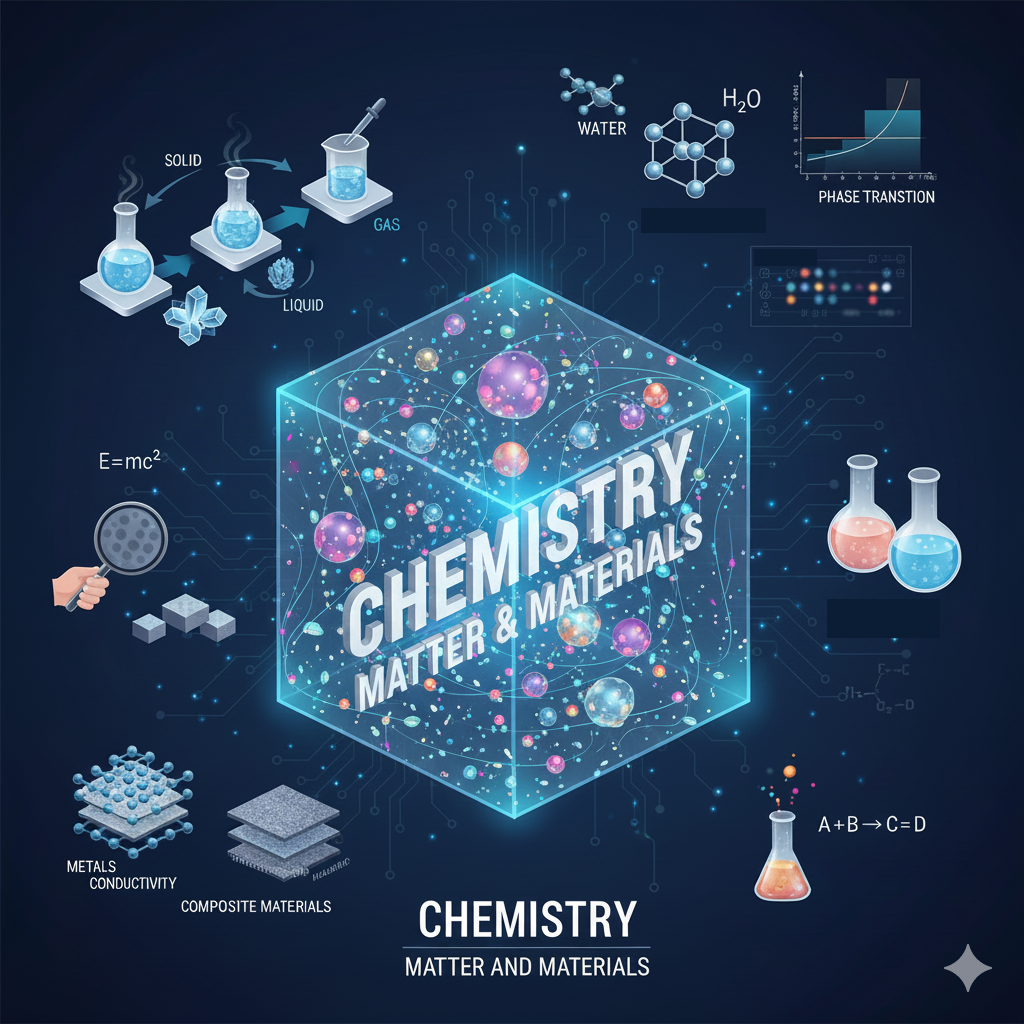
Grade 10: Revision of matter classification, states of matter and the kinetic molecular theory, Atomic Structure, the Periodic Table, and Chemical Bonding (Lewis structures, covalent, ionic, and metallic bonding).
Grade 11: Atomic combinations (molecular structure, shape, and polarity), Intermolecular Forces, and Ideal Gases (gas laws).
Grade 12: Organic Chemistry (naming, structure, properties of hydrocarbons and functional groups) and Organic Macromolecules (polymers).
Chemical Change:
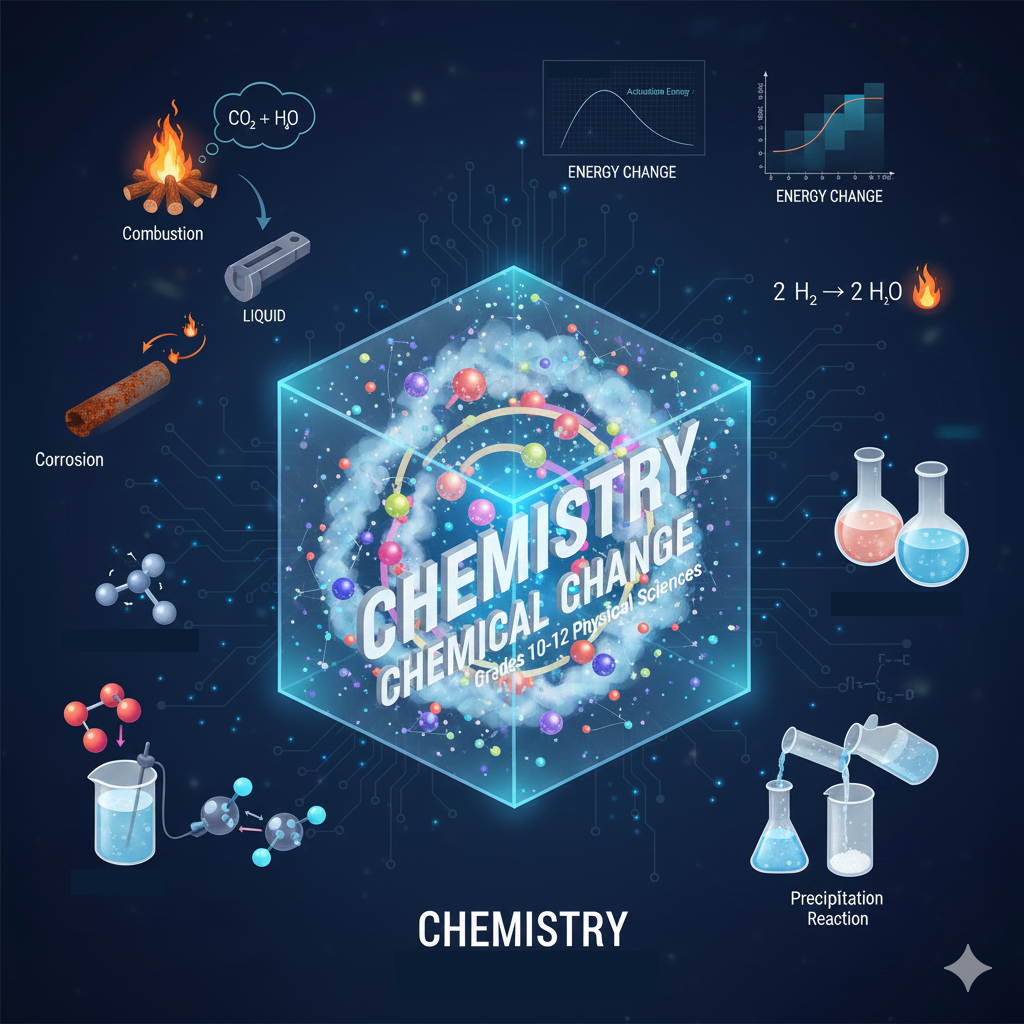
Grade 10: Physical and chemical change, representing chemical change (writing and balancing equations), reactions in aqueous solution (ions, electrolytes), and Quantitative Aspects of Chemical Change (Stoichiometry, atomic mass, the mole, mole calculations).
Grade 11: Stoichiometry (further calculations), Energy and Chemical Change (enthalpy, bond energy), and different Types of Reactions (acids and bases, redox).
Grade 12: Reaction Rate (factors affecting rate, collision theory), Chemical Equilibrium (Le Chatelier’s principle), and advanced Acids and Bases (titrations).
Chemical Systems:
Grade 12: This area is largely focused on Electrochemical Reactions (voltaic and electrolytic cells), which builds on the concepts of redox reactions and chemical change.
Major goals and guiding principles of CAPS for Physical Sciences
The primary goal of the CAPS curriculum for Physical Sciences is to ensure that all learners receive a high-quality education that is both consistent and internationally competitive. In essence, the policy statement aims to equip learners with the scientific knowledge and skills needed for higher education or the workplace.
This national curriculum statement provides a clear framework for basic education, guiding teachers on what to teach and how to assess it. Within the education system, CAPS promotes clarity, depth of knowledge, and a standardised approach, ensuring that every learner has an equal opportunity to succeed in the sciences.
Emphasis on Scientific Inquiry and Critical Thinking
A key principle of the CAPS curriculum for Physical Sciences is fostering scientific inquiry and critical thinking. The curriculum is designed to move learners beyond rote memorisation and encourage them to ask questions, analyse information, and solve complex problems.
This approach creates a dynamic learning environment where learners are active participants in their own education. In South African schools, teachers are encouraged to use practical investigations and real-world examples to help learners connect theoretical concepts to tangible outcomes. This hands-on method makes science more engaging and memorable.
The assessment policy statement supports this by including tasks that test more than just knowledge recall. For example, assessments often require learners to:
Interpret data from graphs and tables.
Design simple experiments to test a hypothesis.
Learner Assessment Criteria and Methods
The assessment policy statement within CAPS provides a very clear and structured framework for evaluating learners.
How is the CAPS curriculum different from previous curriculum models?
One significant difference is its detailed prescription of assessment tasks, ensuring consistency across the entire education system and making evaluations more transparent for learners and parents.
For Physical Sciences, a learner’s final grade is a combination of school-based assessments and the final National Senior Certificate (NSC) examination. This approach ensures that academic performance is measured throughout the year, not just in one final test.
The methods used to assess learners include:
Continuous Assessment: This includes tests, assignments, and practical investigation tasks completed during the school year.
Final Examination: A comprehensive exam at the end of Grade 12 that covers the entire curriculum for the FET phase.
The national curriculum statement provides detailed, week-by-week pacing guides for teachers.
Improvements in clarity, structure, and outcomes
One of the most significant improvements brought by CAPS is the unparalleled clarity it offers teachers. The curriculum provides a comprehensive policy document for each subject at every grade level, outlining precisely what needs to be taught and when. This has created much-needed consistency across schools.
This structured approach ensures better alignment between what is taught in the classroom and what is tested in exams. The assessment policy statement gives teachers clear benchmarks for evaluating learner performance, which helps in identifying learning gaps early on.
The key improvements include:
Reduced Administrative Burden: Teachers spend less time interpreting curriculum requirements and more time on planning effective lessons.
Clearer Learning Pathways: Learners experience a more logical progression of topics from one grade level to the next.
How Teacher and Learner experience has evolved
The introduction of CAPS has notably changed the learning environment for both teachers and learners. For teachers, having clearly defined course guidelines means they can plan with confidence, knowing they are covering all required material in alignment with national standards. This has fostered a more focused and efficient teaching process.
For learners, this consistency means a more predictable and equitable educational journey. Whether a learner is in a rural or urban school, the core curriculum they follow is the same. This inclusive approach is designed to cater to the needs of all learners by providing a stable and uniform foundation.
By standardising the curriculum, CAPS aims to support the diverse needs of learners across the country. This effort toward inclusive education helps ensure that every learner has access to the same opportunities for success, promoting greater fairness and inclusivity within the system.
Conclusion
In summary, the Curriculum Assessment Policy Statements (CAPS) for Physical Sciences represent a significant advancement in educational strategy. By emphasising clarity, structure, and a strong focus on scientific inquiry, CAPS not only enhances the teaching and learning experience but also prepares learners to engage critically with scientific concepts. As we compare CAPS with previous curriculum models, the improvements become clear, showcasing a commitment to better outcomes for both teachers and learners. It is vital for parents to understand this framework in order to support their children effectively. If you have any questions or need further information about CAPS, please don’t hesitate to reach out!
Frequently Asked Questions
What are the main differences between CAPS and other curricula for Physical Sciences?
The CAPS curriculum is a structured, national curriculum with set timelines and exam dates aligned with the South African education system. Other curricula, like Cambridge, offer more flexibility and self-paced learning. The CAPS assessment policy statement is specific to the NSC, whereas international curricula prepare learners for globally recognised exams.
How can parents support learners under the CAPS Physical Sciences curriculum?
Parents can create a supportive learning environment by monitoring their child’s progress, assisting with challenging topics, and encouraging a consistent study routine. Encouraging participation in science-related extracurricular activities can also boost engagement and improve the academic performance of learners, making their schooling experience more enriching.
Is there online support or schooling for Physical Sciences using CAPS in South Africa?
Yes, Doc Scientia offers the full CAPS curriculum for Physical Sciences, online eBooks and courses can be accesses here: https://docscientia.co.za/courses-eng/.
These options provide structured lessons, teacher support, and assessments, allowing learners to complete their schooling from home and often work at their own pace while still following the national curriculum.
Physical Sciences explore the non-living world, focusing on matter and energy through disciplines like Physics and Chemistry.
The main branches of Physical Sciences include Physics, Chemistry, Astronomy, and Earth Science.
This field uses the scientific method to understand everything from chemical reactions to the vastness of space.
Its history is marked by a scientific revolution and groundbreaking theories like quantum mechanics.
Understanding Physical Sciences is key to innovations in technology, medicine, and environmental solutions.
It provides a foundation for numerous rewarding career paths in science, engineering, and research.
Introduction
Welcome to the fascinating world of Physical Sciences! As a major branch of natural science, this field provides the fundamental principles that explain our universe. It is the comprehensive study of matter, energy, and how they interact in non-living systems. From the tiniest particles to the largest galaxies, Physical Sciences helps us understand the rules that govern everything around us. Have you ever wondered how your phone works or what stars are made of? The answers lie within this exciting discipline.
Defining Physical Sciences
Physical Sciences is the scientific discipline dedicated to studying non-living systems and their physical properties. In contrast to life sciences, which focus on living organisms, this field investigates the nature of energy and matter. It seeks to uncover the fundamental laws that dictate how the physical world behaves.
By applying Physical Sciences principles, we can explain and predict a wide range of natural phenomena. In the sections that follow, we will explore the specific meaning and scope of this field, see how it connects to other areas of study, and look at its place within educational frameworks.
Meaning and Scope of Physical Sciences
The core meaning of Physical Sciences lies in its systematic approach to understanding the universe. It involves a general analysis of nature, using the scientific method to form and test hypotheses based on observation and experimentation. This rigorous process allows scientists to uncover the principles governing natural phenomena.
Its scope is incredibly vast, stretching from the subatomic to the cosmic. At one end, it examines the particles that make up atoms. At the other, it explores the formation of stars, planets, and entire galaxies. This broad range makes it a foundational science for many other fields.
Ultimately, Physical Sciences aims to provide a coherent and unified explanation for how the world works. The main branches that accomplish this are Physics, Chemistry, astronomy, and Earth science, each contributing a unique perspective to our understanding of non-living systems.
How Physical Sciences Relate to Other Fields
Physical Sciences doesn’t exist in a vacuum; its principles are deeply interconnected with other scientific disciplines. The main difference between Physical Sciences and life science is its focus—Physical Sciences studies non-living matter and energy, while life science studies living organisms. However, these fields often overlap. For example, biochemistry uses Chemistry to explain processes within living cells.
Furthermore, related concepts from Physical Sciences are essential in fields like computer science. The development of semiconductors and electronic components, which are the backbone of modern computing, is a direct result of understanding the physical properties of materials like silicon.
These connections have led to the rise of many interdisciplinary fields. Biophysics applies the laws of Physics to biological systems, and quantum computing merges quantum mechanics with information theory. This shows how Physical Sciences provides the fundamental building blocks for advancements across the scientific spectrum.
Physical Sciences in the South African CAPS Curriculum
Educational systems worldwide, including the CAPS curriculum in South Africa, recognise Physical Sciences as a cornerstone of a well-rounded education. As a key part of natural science, it equips students with critical thinking and problem-solving skills that are valuable in any career. The curriculum is typically designed to build a strong foundation in the core concepts of both Physics and Chemistry.
The structure of such a curriculum aims to prepare students for higher education and technical fields. It presents complex ideas in a logical sequence, starting with fundamental principles and progressing to more advanced topics. This approach ensures that learners grasp the connections between different concepts.
For instance, a grade 12 Physical Sciences curriculum would likely cover mechanics, electricity, and waves in Physics, alongside stoichiometry and organic Chemistry in the Chemistry portion. This comprehensive study helps students understand both the “how” and “why” of the physical world, preparing them for future challenges.
The Historical Development of Physical Sciences
The history of science shows us a remarkable journey of discovery, and the development of Physical Sciences is a central part of that story. What began as natural philosophy in ancient times has evolved into the precise, evidence-based disciplines we know today. This transformation was powered by curiosity and a relentless pursuit of knowledge.
A pivotal moment was the scientific revolution, which established a new framework for investigation. This led to centuries of breakthroughs, culminating in modern theories like quantum mechanics that reshaped our understanding of reality. We’ll now look at some of the key milestones in this incredible history.
Early Discoveries and Ancient Contributions
The roots of Physical Sciences trace back to ancient civilisations. Early cultures in Sumeria and Egypt developed a basic, predictive knowledge of the movements of the Sun, Moon, and stars, which was crucial for agriculture and navigation. This early astronomy marked the first attempts at a general analysis of nature.
The ancient Greek philosophers took this a step further by seeking to explain the world through reason rather than myth. Thinkers like Aristotle engaged in natural philosophy, proposing theories about matter, motion, and the cosmos. Although not based on empirical testing as we know it today, their work laid the intellectual groundwork for future scientific inquiry.
These early contributions were essential. They fostered a culture of questioning and observation that became the seed from which the scientific method would eventually grow, setting the stage for more rigorous exploration in the centuries to come.
Scientific Revolution and Modern Advances
The scientific revolution, beginning in the 16th century, marked a dramatic shift in how knowledge was pursued. Thinkers like Copernicus, Galileo, and Newton challenged long-held beliefs and championed a new approach based on empirical evidence and mathematical principles. This period saw the natural sciences emerge as distinct research fields separate from philosophy.
This momentum continued through the 19th century, which brought major breakthroughs in understanding electricity, magnetism, and thermodynamics. The development of a formal atomic theory transformed Chemistry from a qualitative practice into a quantitative science, allowing for precise predictions about chemical reactions.
These advances established the fundamental principles that still underpin much of Physical Sciences today. The emphasis on rigorous experimentation and mathematical rigor during this era created the foundation for the even more revolutionary discoveries that the 20th century would bring.
Milestones in Physics and Chemistry
The 20th century was a golden age for Physical Sciences, with milestones that fundamentally altered our view of the universe. Albert Einstein’s theory of relativity revolutionised our understanding of space, time, and gravity, while the development of quantum mechanics provided a strange but incredibly accurate description of the subatomic world.
These new ideas didn’t entirely replace older ones like Newton’s laws of motion; instead, they revealed their limitations and provided a more complete picture. As physicist Richard Feynman noted, “If, in some cataclysm, all of scientific knowledge were to be destroyed…the most information in the fewest words…is that all things are made up of atoms.” [1]
In Chemistry, the ability to understand atomic structure led to a deeper knowledge of chemical bonding and reactions. This paved the way for the creation of new materials, medicines, and technologies, demonstrating the powerful synergy between breakthroughs in Physics and Chemistry.
Evolution of Physical Sciences Education in South Africa
The evolution of Physical Sciences education, in places like South Africa and elsewhere, reflects the progress of the science itself. Early education often focused on memorising facts and formulas. However, modern approaches, such as those intended by frameworks like the CAPS curriculum, emphasise inquiry-based learning and conceptual understanding.
This shift encourages students to think like scientists—to ask questions, design experiments, and interpret data. The goal of Physical Sciences education today is not just to transfer knowledge but to cultivate skills in critical thinking, problem-solving, and analysis. This prepares learners for a world where scientific literacy is increasingly important.
The curriculum is designed to be relevant, connecting abstract principles to real-world applications in technology and industry. By focusing on both foundational knowledge and practical skills, modern Physical Sciences education in South Africa and globally aims to inspire the next generation of innovators and thinkers.
Main Branches of Physical Sciences
Physical Sciences is a vast field, but it can be broken down into more focused disciplines. Traditionally, it is divided into four main branches, each offering a unique lens through which to view the non-living world. Understanding these branches helps to appreciate the breadth and depth of the field.
These branches of Physical Sciences are Physics, Chemistry, astronomy, and Earth science. While they each have their own specific areas of study, they are highly interconnected, often relying on each other’s principles to answer complex questions. Let’s explore what each of these branches entails.
Understanding Physics: Key Concepts and Fields
Physics is arguably the most fundamental of the Physical Sciences. It is the study of matter, energy, and the forces that govern their interactions in space and time. The goal of Physics is to understand how the universe behaves at the most basic level.
The main branches of Physics include classical mechanics, which describes the motion of objects we see every day, and modern Physics, which includes mind-bending theories like relativity and quantum mechanics. Other key fields are thermodynamics (the study of heat and energy), electromagnetism, and acoustics (the study of sound).
By exploring these concepts, physicists uncover the laws that govern everything from the flight of a baseball to the fusion reactions inside stars. Its focus on fundamental forces and energy is what distinguishes it from Chemistry, which concentrates more on the composition and properties of substances.
Exploring Chemistry: Subfields and Fundamentals
Chemistry is often called the central science because it bridges Physics with other natural sciences, including biology. It focuses on the composition, structure, properties, and changes of matter. Have you ever wondered why iron rusts or how baking soda reacts with vinegar? Chemistry holds the answers.
This discipline studies how chemical elements and different substances interact, form new compounds, and undergo reactions. Key subfields include organic Chemistry (the study of carbon-based compounds), inorganic Chemistry, and physical Chemistry, which applies principles of Physics to chemical systems. Other important areas are analytical Chemistry and quantum Chemistry.
While Physics looks at the fundamental forces, Chemistry is more concerned with how atoms and molecules behave and rearrange themselves. This focus on the interactions of matter at the atomic and molecular level is the key difference between the two fields.
Astronomy and Its Importance
Astronomy is the branch of Physical Sciences that takes our gaze to the stars. It is the scientific study of celestial bodies, including planets, stars, moons, comets, and galaxies. Astronomers use principles from Physics and Chemistry to understand these objects and the universe as a whole.
This field seeks to answer some of the biggest questions we have: How did the universe begin? Are there other planets like Earth? What happens inside a black hole? Theories like the Big Bang theory provide a framework for understanding the origin and evolution of the cosmos, while observations of our solar system give us clues about planet formation.
Astronomy is important not only for satisfying our curiosity but also for its practical applications. It drives the development of cutting-edge technology in optics, imaging, and data analysis and helps us understand our place in the universe.
Earth Science in the Physical Sciences Spectrum
Earth science brings the focus of Physical Sciences back to our home, planet Earth. Also known as geoscience, this branch is an all-encompassing term for the sciences related to our world. It includes geology (the study of rocks and the solid Earth), meteorology (the study of the atmosphere and weather), and oceanography (the study of the oceans).
Earth scientists use tools and principles from Physics, Chemistry, and biology to understand how our planet works. They study the properties of matter to understand rock formation, apply fluid dynamics to predict weather patterns, and analyse chemical cycles in the oceans.
Understanding Earth science is crucial for managing natural resources, predicting natural disasters like earthquakes and hurricanes, and addressing environmental challenges such as climate change. It gives us the knowledge needed to live sustainably on our dynamic and ever-changing planet.
Physical Sciences Versus Life Science
Natural science is broadly divided into two major categories: Physical Sciences and life science. The fundamental distinction between them lies in their subject matter. While Physical Sciences is concerned with non-living systems, life science is the study of living organisms.
This core difference shapes their focus, methods, and the types of questions they seek to answer. Physical Sciences investigates physical properties and universal laws, whereas life science explores complex biological phenomena. Let’s examine these distinctions and overlaps more closely.
Distinctions in Subject Matter
The primary distinction between physical and life science is what they study. Physical Sciences focuses on the inanimate world, from the smallest particles to the largest structures in the universe. Life science, on the other hand, is dedicated to understanding living things in all their forms.
Thinking about their core questions can clarify the difference in subject matter. Physical Sciences asks questions about the fundamental nature of matter and energy, while life science asks how organisms survive, reproduce, and evolve.
Here are some key distinctions:
Physical Sciences studies matter, energy, forces, and motion.
Life Science studies cells, genetics, ecosystems, and evolution.
Physical Sciences explores the laws governing non-living systems.
Life Science investigates the complex processes that define life.
Overlapping Concepts and Interdisciplinary Areas
Despite their differences, these two main branches of natural science are not completely separate. Many of the most exciting discoveries today are happening at their intersection. Living organisms, after all, are made of matter and run on energy, so the laws of Physics and Chemistry still apply.
This overlap creates a rich ground for interdisciplinary study. For example, related concepts from both fields are combined in biochemistry, which uses chemical principles to explain biological processes like metabolism. Similarly, Biophysics applies the theories and methods of Physics to understand how cells move or how nerves transmit signals.
These connections show that a complete understanding of the natural world requires insights from all scientific disciplines. The boundaries are becoming increasingly blurred as scientists work together to solve complex problems in health, environment, and technology.
The CAPS Physical Sciences Curriculum in South Africa
Educational frameworks like the CAPS curriculum in South Africa provide a structured pathway for students to learn Physical Sciences. This curriculum is designed to give learners a comprehensive and integrated understanding of both Physics and Chemistry, treating them as two parts of a single, coherent subject.
The goal is to build a solid foundation of knowledge and practical skills that prepares students for tertiary education and careers in scientific and technical fields. The following sections detail the structure and key topics typically found in a high school Physical Sciences curriculum.
Overview of CAPS Documents and Curriculum Policy
The CAPS (Curriculum and Assessment Policy Statements) documents serve as a vital framework for the delivery of Physical Sciences education in South Africa. This structured policy outlines the essential curriculum content, assessment methodologies, and educational outcomes designed to equip learners with a deep understanding of both Physics and Chemistry. Each document emphasises a student-centered approach to education, promoting critical thinking and scientific inquiry. By clearly delineating the key concepts and skills required at each grade level, CAPS ensures that teaching is aligned with national standards and expectations. It provides teachers with a comprehensive guide, facilitating effective lesson planning and ensuring that all learners are adequately prepared for assessments. Furthermore, these documents emphasise the integration of practical activities, which are crucial for fostering a hands-on understanding of scientific principles, thus making the study of Physical Sciences both relevant and engaging for students.
Curriculum Structure and Grade 12 Focus Areas
A typical Grade 12 Physical Sciences curriculum is carefully structured to cover advanced topics in both Physics and Chemistry. The year’s work builds upon concepts learned in previous grades, challenging students to apply their knowledge to more complex problems. The topics are usually divided into two main papers or sections, one for each discipline.
This structure ensures that learners receive a balanced education in both areas. The focus is not just on theory but also on practical application and problem-solving, which are crucial skills for any aspiring scientist or engineer.
Here is an example of what the focus areas in a Grade 12 curriculum might look like:
Focus Area
Key Topics Covered
Physics
Mechanics (Momentum, Work-Energy-Power), Waves, Sound and Light, Electricity and Magnetism, Matter and Materials
Chemistry
Chemical Change (Rates and Extent of Reaction, Equilibrium), Electrochemical Reactions, Chemical Systems (Organic Chemistry)
Key Topics Covered in Physics
The Physics portion of a Grade 12 curriculum delves into some of the most important principles that describe our physical world. Students move beyond basic descriptions to perform quantitative analysis, applying mathematical formulas to solve real-world problems.
These topics are chosen to provide a broad understanding of both classical and modern Physics concepts. They form the foundation for further study in engineering, astrophysics, and other Physics-related fields. Do you wonder how electric motors work or why a rainbow forms? These topics provide the answers.
Key Physics topics often include:
Newton’s Laws of Motion: Including momentum, impulse, and the conservation of momentum.
Work, Energy, and Power: Focusing on the conservation of energy principle.
Waves, Sound, and Light: Exploring phenomena like the Doppler effect and diffraction.
Electricity and Magnetism: Covering circuits, motors, and electromagnetic induction.
Key Topics Covered in Chemistry
In Chemistry, Grade 12 students explore the dynamic nature of matter and its transformations. The focus shifts towards understanding the rates and mechanisms of chemical reactions, as well as the properties of more complex chemical compounds.
This part of the curriculum is essential for students interested in medicine, pharmacology, materials science, or chemical engineering. It provides the knowledge needed to understand everything from how batteries work to the synthesis of plastics and medicines. Exploring the nature of chemical bonds is central to this understanding.
Key Chemistry topics often include:
Rates and Extent of Reaction: Studying factors that affect reaction speed and chemical equilibrium.
Electrochemical Reactions: Investigating galvanic and electrolytic cells.
Acids and Bases: Defining and calculating pH, and exploring titration.
Organic Chemistry: Naming, properties, and reactions of different families of organic compounds.
Practical Work and Assessment Standards
Practical work is a non-negotiable component of any Physical Sciences curriculum. It is where theory meets reality, allowing students to observe phenomena firsthand and develop crucial laboratory skills. Assessment standards require learners to demonstrate their ability to apply the scientific method.
This hands-on experience involves designing investigations, collecting and analysing data, and drawing valid conclusions. It reinforces conceptual understanding and teaches students to think critically about experimental results. Are you ready to put on a lab coat and see science in action?
Effective practical work and assessment focus on:
Scientific Investigation: Following a structured process to answer a scientific question.
Data Handling: Recording observations accurately and representing data in tables and graphs.
Safety: Adhering to safety protocols to ensure a secure laboratory environment.
Core Principles in Physics
At the heart of Physics are a set of core principles that provide a framework for understanding the universe. These laws of Physics are not just abstract ideas; they are powerful tools that describe everything from the motion of planets to the behavior of light. These are some of the most fundamental Physical Sciences principles.
Understanding these concepts is essential for grasping how the world works on a fundamental level. They explain the “why” behind the phenomena we observe every day. Let’s explore some of the most important principles in Physics.
Motion, Forces, and Energy
One of the first areas of study in Physics is the relationship between motion, forces, and energy. These concepts are described beautifully by Newton’s laws of motion, which form the foundation of classical mechanics. They explain why an object at rest stays at rest and why it takes more force to move a heavier object.
Forces are the pushes and pulls that cause objects to accelerate, or change their motion. Energy, on the other hand, is the capacity to do work. A key idea is the conservation of energy, which states that energy cannot be created or destroyed, only transformed from one form to another.
Understanding these principles is crucial for designing everything from bridges to spacecraft. They allow us to predict the trajectory of a ball, calculate the power of an engine, and understand the orbits of planets.
Electricity and Magnetism
Electricity and magnetism were once thought to be separate forces, but physicists in the 19th century discovered they are two sides of the same coin. This unified force, known as electromagnetism, is one of the four fundamental forces of nature. It governs the interactions between charged particles.
The principles of electricity describe the flow of charge and the behavior of electric circuits. Magnetism explains the forces exerted by magnets and the magnetic fields created by moving charges. The interplay between them is responsible for countless technologies, including electric motors, generators, and transformers.
Understanding the physical properties related to this electromagnetic force is what makes modern life possible. It powers our homes, runs our electronics, and enables global communication through radio waves and the internet.
Waves, Sound, and Light
Waves are disturbances that transfer energy from one place to another without transferring matter. In Physics, we study different types of waves, including mechanical waves like sound and water waves, and electromagnetic waves like light and radio waves.
Sound is a wave that travels through a medium, like air or water, by causing vibrations. Its properties, such as pitch and loudness, are determined by the wave’s frequency and amplitude. Light, however, is a fascinating type of wave that can travel through the vacuum of space. It is part of a vast electromagnetic spectrum that includes everything from radio waves to gamma rays.
Understanding wave behavior is critical for many technologies. It explains how musical instruments work, how we see colors, and how Wi-Fi signals travel through our homes.
Core Principles in Chemistry
Just as Physics has its core principles, the study of Chemistry is built on a foundation of fundamental concepts. These principles help us understand what matter is made of and how it changes from one substance to another. They are the key to unlocking the world of molecules and chemical reactions.
From the structure of atoms to the nature of chemical bonds, these ideas provide a framework for explaining the properties and behavior of the millions of different substances that exist. Let’s examine some of the core principles of Chemistry.
Atomic Structure and The Periodic Table
The most basic principle in Chemistry is that all matter is composed of atoms. Understanding the atomic structure—the arrangement of protons, neutrons, and electrons within an atom—is the key to understanding all of Chemistry. The number of protons defines what element an atom is, while the electrons determine its chemical behavior.
The Periodic Table is one of the most powerful tools in science. It organises all known chemical elements based on their atomic number and electron configurations. This brilliant arrangement allows chemists to predict an element’s properties and how it will react with other elements just by looking at its position on the table.
This organisation reveals trends in properties like atomic size and reactivity, making the periodic table an indispensable guide for anyone studying or working with chemical substances.
Chemical Reactions and Equations
Chemistry is fundamentally about change. Chemical reactions are the processes that transform one set of chemical substances into another. These reactions of matter are happening all around us and inside us, from the rusting of a nail to the digestion of food.
Chemists use chemical equations to represent these transformations in a concise and universal language. These equations show the starting materials (reactants) and the resulting substances (products), and they must be balanced to reflect the law of conservation of mass.
This principle states that matter is not created or destroyed in a chemical reaction. Understanding how to write and balance equations is crucial for predicting the outcomes of reactions, including those used in chemical synthesis to create new medicines and materials.
Solutions, Acids, and Bases
Many chemical reactions take place in solutions, which are homogeneous mixtures of two or more substances. Understanding how substances dissolve and interact in a solution is a core part of Chemistry.
Among the most important types of substances are acids and bases. These compounds are defined by their ability to donate or accept protons, and their reactions are fundamental to countless processes in industry, the environment, and biology. The pH scale is used to measure the acidity or basicity of a solution.
The study of acids, bases, and solutions is a major part of analytical Chemistry. Techniques like titration allow chemists to determine the precise concentration of a substance in a solution, a skill that is vital in quality control, medical testing, and environmental monitoring.
Relationships Within Physical Sciences
The branches of Physical Sciences are not isolated islands of knowledge. They are deeply interconnected, forming a web of related concepts that together provide a powerful understanding of the universe. As fundamental sciences, they all rely on the scientific method to build and test knowledge.
The relationship between Physics and Chemistry is particularly strong, as are their connections to mathematics and technology. Exploring these relationships reveals how progress in one area often drives breakthroughs in others. Let’s look at how these fields interact.
How Physics and Chemistry Interact
The line between Physics and Chemistry often blurs, especially in the fields of physical Chemistry and chemical Physics. Physical Chemistry uses fundamental principles from Physics—such as thermodynamics, quantum mechanics, and statistical mechanics—to study and explain chemical phenomena. Why do reactions release heat? How fast do they happen? Physical Chemistry provides the answers.
On the other hand, chemical Physics uses methods from Chemistry to investigate problems in Physics. For example, understanding the chemical properties of materials is essential for developing new semiconductors or superconductors.
This interaction is a two-way street. Physics provides the “why” for many chemical rules, explaining the forces that govern atomic and molecular behavior. In turn, Chemistry provides the practical knowledge of how to build complex molecules and materials, which can then be used to test physical theories.
Role of Mathematics in Physical Sciences
Mathematics is often called the language of the universe, and for good reason. In Physical Sciences, it is an essential tool for expressing theories, making predictions, and analysing data. Without mathematics, the precise and quantitative nature of the scientific method would be impossible.
From the simple equations of motion to the complex calculus used in quantum mechanics, mathematics allows scientists to build models that describe physical reality. While you can understand many foundational concepts without advanced math, higher studies and research in Physics and Chemistry require strong mathematical skills.
This reliance on mathematics is one of the defining features of Physical Sciences. It provides the rigor needed to turn qualitative observations into quantitative laws, allowing for predictions that can be tested with extraordinary accuracy.
Physical Science’s Connections with Technology
The relationship between Physical Sciences and technology is a powerful cycle of innovation. Discoveries in this scientific discipline provide the foundational knowledge that engineers and inventors use to create new technologies. In return, these new technologies provide scientists with more advanced tools to make further discoveries.
For example, the understanding of electromagnetism led to the invention of radio, television, and the internet. The study of the physical properties of silicon led to the creation of the transistor and the microchip, which power all modern electronics.
Every piece of technology you use, from your smartphone to your car, is a product of our understanding of Physical Sciences. This deep connection ensures that as our scientific knowledge grows, so too will our technological capabilities, leading to innovations that continue to shape our world.
Applications of Physical Sciences in Everyday Life
You might think of Physical Sciences as something that happens only in a lab, but its impact is all around you, every single day. The study of matter and its physical properties is the driving force behind most of the new technologies and conveniences that define modern life.
From the moment you wake up until you go to sleep, you are interacting with the applications of Physical Sciences. Understanding these applications shows just how important this field is. Let’s explore some of the ways it shapes our world.
Innovations in Medicine and Health
The field of medicine owes a great deal to innovations rooted in Physical Sciences. Diagnostic imaging techniques that allow doctors to see inside the human body without surgery are a prime example. X-rays, Magnetic Resonance Imaging (MRI), and CT scans are all direct applications of Physics principles.
Similarly, treatments like radiation therapy for cancer rely on a deep understanding of nuclear Physics and how radiation interacts with living tissue. Even the development of new drugs in the health sector is guided by Chemistry, which helps create molecules that can target specific diseases.
These life-saving technologies demonstrate the profound impact that Physical Sciences has on human well-being. By applying fundamental principles, scientists and doctors have developed powerful tools to diagnose and treat illnesses, extending and improving countless lives.
Physical Science’s Impact on Environment and Sustainability
Addressing the world’s environmental challenges would be impossible without Physical Sciences. The study of our climate and the impact of greenhouse gases is rooted in Chemistry and Physics. This knowledge allows scientists to model climate change and predict its effects, providing the data needed to inform policy decisions.
Furthermore, the quest for sustainability is driving innovation in energy. The development of renewable energy sources, such as solar panels and wind turbines, relies on principles of Physics. Solar panels convert light into electricity through the photovoltaic effect, a quantum mechanical process.
Chemists are also working to create better batteries for storing this energy, developing new ways to recycle materials, and finding methods to control pollution. These efforts are crucial for building a sustainable future for our planet.
Technology and Infrastructure Developments
Nearly every piece of modern technology and infrastructure is a testament to the power of Physical Sciences. The buildings we live and work in are constructed from materials like steel and concrete, whose strength and durability are understood through the study of their physical properties.
Our global communication network, from fiber optic cables to satellites, is built on our understanding of light and electromagnetic waves. The smartphones in our pockets are marvels of condensed matter Physics and Chemistry, containing processors, screens, and batteries that are all products of advanced materials science.
Even our transportation systems, whether cars, trains, or airplanes, are designed using principles of mechanics, thermodynamics, and aerodynamics. These developments show that Physical Sciences is quite literally the foundation of the modern world.
Experiments and Practical Activities in Physical Sciences Classes
Learning Physical Sciences is not just about reading textbooks; it is about doing. Hands-on experiments and practical activities are where students truly connect with the concepts. These activities are essential for developing crucial laboratory skills and gaining a deep, intuitive understanding of the scientific method.
By conducting experiments, you can see principles in action, learn to handle equipment, and practice the art of observation and analysis. So, what kind of practical work can you expect to do in a Physical Sciences class?
Common Experiments in Physics
Physics experiments are designed to make abstract concepts tangible. They allow you to test the laws of nature for yourself and see how mathematical formulas translate into real-world results. These experiments often involve taking careful measurements and analysing them to verify a physical principle.
Following the scientific method, you will form a hypothesis, conduct the experiment, and then draw a conclusion based on your data. This process is at the heart of all scientific discovery. Are you curious about what you might get to do?
Common Physics experiments include:
Verifying Ohm’s Law: Building simple circuits to measure voltage, current, and resistance.
Investigating Projectile Motion: Launching a ball and measuring its path to understand gravity and motion.
Studying the Conservation of Energy: Using a pendulum or a rolling cart to show how potential energy converts to kinetic energy.
Exploring Wave Properties: Using a ripple tank or springs to observe reflection, refraction, and interference.
Frequently Performed Chemistry Lab Activities
Chemistry laboratory activities are often vibrant, with color changes, fizzing, and other visible signs of chemical reactions. These activities are designed to teach you about the properties of substances, how they change, and how to identify unknown materials.
Working in a Chemistry lab helps you develop precision in measurement and observation. You will learn how to handle chemicals safely and use specialised glassware and equipment to carry out reactions.
Frequently performed Chemistry labs include:
Acid-Base Titration: Carefully neutralising an acid with a base to determine its concentration.
Chemical Synthesis: Creating a new compound, such as aspirin or a polymer, from simpler reactants.
Identifying Unknowns: Using a series of tests for physical and chemical properties to identify an unknown substance.
Measuring Reaction Rates: Observing how factors like temperature or concentration affect the speed of a chemical reaction.
Safety Protocols and Laboratory Skills
Safety is the most important laboratory skill of all. A Physical Sciences lab contains chemicals, glassware, and equipment that can be hazardous if not handled correctly. Learning and following safety protocols is the first and most critical step in any practical activity.
Beyond safety, you will develop a range of valuable skills. These include making precise measurements, keeping a detailed and accurate lab notebook, and working effectively as part of a team. These skills are transferable and highly valued in many professions, even outside of science.
Key safety protocols and skills include:
Always Wear Safety Goggles: Protecting your eyes is the number one rule in any lab.
Proper Chemical Handling: Knowing how to safely measure, mix, and dispose of chemicals.
Using Equipment Correctly: Understanding how to operate burners, glassware, and measurement devices safely and effectively.
Learning Resources for Physical Sciences in South Africa
Whether you are a student in South Africa or anywhere else, having access to good learning resources is key to success in Physical Sciences. A combination of quality textbooks, engaging online platforms, and collaborative study can make a huge difference in your understanding.
When choosing a textbook, look for one that does more than just present facts. A good book will provide clear explanations, worked examples, and plenty of practice problems to help you master the material.
Features to look for in a good textbook include:
Clear Alignment with the Curriculum: Ensures all necessary topics are covered.
Worked Examples: Step-by-step solutions to problems that show you the thinking process.
Practice Questions: A variety of questions to test your understanding and prepare for exams.
Well-Designed Diagrams and Illustrations: Visual aids that help explain complex concepts.
Mind Maps and Summaries: Highlighting the key concepts of the theory covered.
Career Opportunities for Physical Sciences Learners
A background in Physical Sciences opens the door to a vast array of exciting and rewarding career opportunities. The analytical, problem-solving, and quantitative skills you develop are highly sought after in many different professions, both inside and outside of science.
Whether you are interested in research, technology, healthcare, or even finance, a qualification in Physical Sciences can be your ticket to a successful career. Let’s look at some of the paths you could take.
Careers in Physics and Engineering
With a degree in Physics, you could pursue a career as a research physicist, working at a university or a national laboratory to push the boundaries of human knowledge. Physicists work in fields like particle Physics, astrophysics, and condensed matter Physics.
Many Physics graduates also go into engineering. The strong foundation in mathematics and problem-solving is perfect for fields like electrical, mechanical, and aerospace engineering. Engineers use scientific principles to design and build the technology and infrastructure that society depends on.
Other career opportunities include roles in data science, finance, and software development, where the ability to model complex systems is highly valued. A Physics education teaches you how to think, a skill that is applicable anywhere.
Chemistry-Based Professions
Several exciting careers stem from the study of Chemistry, each playing a vital role in understanding and utilising the properties of matter. From pharmaceutical developers who design life-saving medications to materials scientists who innovate new materials and explore their physical properties, Chemistry-based professions are diverse and impactful. Environmental chemists contribute to solving pressing issues by analysing pollutants and finding ways to mitigate their effects. Additionally, educators who inspire the next generation through the scientific method are paramount in fostering an appreciation for this branch of natural science. Ultimately, these careers offer opportunities to make a difference in today’s world.
Emerging Fields in Physical Sciences
Rapid advancements in Physical Sciences have given rise to exciting new fields, captivating the interest of scientists and enthusiasts alike. Areas such as quantum Chemistry and condensed matter Physics are exploring the behavior of matter at atomic and molecular levels, revealing unique properties that can transform technology. Furthermore, the integration of computer science with natural phenomena studies has paved the way for innovative solutions in materials science and space exploration. As researchers probe deeper into the laws of motion and energy conservation, these emerging disciplines promise to enhance our understanding of the universe and its fundamental principles.
Advice for Career Planning After Grade 12
Exploring options after grade 12 can be exciting yet daunting. A solid understanding of Physical Sciences opens doors to numerous Chemistry-based professions, from pharmaceuticals to environmental science. Embrace the scientific method; conduct your own research to discover which fields resonate with your interests and strengths. Networking with professionals already in your preferred branch of science, such as material science or nuclear Physics, can provide valuable insights. Additionally, consider internships or volunteering to gain first-hand experience, as these opportunities can clarify your career path while honing your skills in areas like chemical reactions and the properties of matter.
Conclusion
In exploring the vast landscape of Physical Sciences, we’ve uncovered the intricate connections between various branches, from Chemistry to Physics. This rich tapestry not only enhances our understanding of natural phenomena but also prepares us for future innovations. By applying the scientific method and delving into the properties of matter and energy conservation, we embark on a journey that stretches from the microscopic world of atomic hypotheses to the grand expanses of celestial bodies. Embracing this knowledge signifies an openness to new technologies and discoveries—key components to navigate the evolving realm of science in our everyday lives.
Frequently Asked Questions
What are the four main branches of Physical Sciences?
The four main branches of Physical Sciences include Physics, Chemistry, astronomy, and Earth sciences. Each branch explores different aspects of the physical universe, from the fundamental properties of matter to celestial phenomena and the Earth’s processes. Understanding these branches is essential for aspiring scientists.
How is Physical Sciences used in South African industries?
Physical Sciences is crucial in South African industries, driving advancements in sectors like mining, agriculture, and energy. Its principles enhance processes such as material analysis and environmental monitoring, fostering innovation and sustainability while ensuring compliance with safety regulations to optimise productivity and resource utilisation.
What skills are developed by studying Physical Sciences?
Studying Physical Sciences enhances critical thinking, problem-solving, and analytical skills. Students learn to conduct experiments, analyse data, and understand scientific principles, fostering creativity and innovation. These skills are vital for various professions in technology, engineering, and environmental science.