CAPS for Physical Sciences – Key Highlights
- The CAPS curriculum is the national curriculum statement for schools in South Africa, providing a standardised education system. It offers clear, detailed guidelines for each subject and grade, including what learners should know and be able to do.
- It offers clear, detailed guidelines for each subject and grade, including what learners should know and be able to do.
- The assessment policy statement within CAPS outlines specific criteria for evaluating learner performance consistently.
- For Physical Sciences, CAPS defines the core content areas, from foundational concepts in earlier grades to specialised topics in high school.
- This framework aims to reduce the administrative burden on teachers and ensure all learners receive a quality education.
Introduction
Welcome to our guide on the Curriculum and Assessment Policy Statements, better known as CAPS. If you’re a parent or learner in the South African education system, you’ve likely heard this term a lot. Developed by the Department of Basic Education, CAPS is the national curriculum that structures teaching and learning across the country. This guide will walk you through what CAPS means for Physical Sciences, from its core principles to how it shapes the classroom experience and prepares learners for their future. If you are looking for a detailed guide about CAPS in education, you are in the right place—this resource will provide comprehensive information to help you understand every aspect of CAPS.
Defining CAPS in the context of Physical Sciences
So, what does CAPS stand for in the South African education system? CAPS is an acronym for Curriculum and Assessment Policy Statement. This comprehensive policy statement provides a single, clear, and detailed framework for all subjects taught in schools, including Physical Sciences.
The CAPS curriculum is not a brand new curriculum but an amendment of the previous National Curriculum Statement. Its main purpose is to ensure that every learner, regardless of their school, has access to a consistent and high-quality learning environment.
The origin and purpose of CAPS in South Africa
The Department of Basic Education introduced CAPS to streamline and strengthen the national curriculum. Before its implementation, teachers were working with a system that was often seen as administratively heavy and open to interpretation. This led to inconsistencies in teaching and learning across South Africa.
The primary purpose of this policy statement was to provide clear, grade-by-grade guidelines. For every subject, CAPS details what content needs to be covered, in what sequence, and within what timeframe. This ensures a standardised approach to basic education nationwide.
Ultimately, the goal was to lessen the administrative load on educators and give them a well-defined roadmap. This allows teachers to focus more on instruction and helps ensure that all learners are prepared for the same academic milestones, creating a more equitable education system.
How CAPS shapes Physical Sciences teaching
When it comes to Physical Sciences, CAPS provides a highly structured approach that transforms the learning environment. The curriculum specifies the exact topics and experiments that learners must engage with from Grade 10 to 12. One of the main goals of the CAPS curriculum is to create consistency, ensuring that learners in all South African schools are learning the same fundamental principles of Physics and Chemistry.
This structured approach helps teachers plan their lessons effectively. The assessment policy statement gives them clear instructions on how to evaluate learner progress through tests, practical assessments, and final exams. It standardises expectations across the education system.
Here’s how CAPS directly influences Physical Sciences teaching:
- Structured Content: It provides a detailed, term-by-term plan of topics, from mechanics and electricity to chemical reactions.
- Standardised Assessments: It sets the format and cognitive levels for tests and exams to ensure fairness.
- Practical Work: It mandates specific practical experiments to develop scientific skills.
Structure of the CAPS curriculum for Physical Sciences
The CAPS curriculum is organised into distinct curriculum phases, guiding a learner’s journey from early childhood education to their final high school exams. This structure ensures that learning builds progressively, with foundational concepts introduced early on to support more complex subjects later. For South African schools, this phased approach is a core part of the national curriculum statement.
Each phase has its own focus and set of subjects designed to be age-appropriate. The journey towards Physical Sciences begins long before Grade 10, with subjects in earlier grades laying the necessary groundwork in mathematics and scientific principles.
Curriculum Phases and Grade Breakdown
The South African education system under CAPS is divided into four main phases, each covering specific grades. This structure ensures a smooth progression from one grade level to the next, creating a cohesive learning environment from start to finish.
The journey begins with the Foundation Phase, which focuses on basic literacy and numeracy. As learners advance, the subjects become more specialised, preparing them for the choices they will make in the final FET Phase, where they can select subjects like Physical Sciences.
Here is a simple breakdown of the curriculum phases and the grades they include within the CAPS system:
|
Phase |
Grades Covered |
|
Foundation Phase |
Grade R – 3 |
|
Intermediate Phase |
Grade 4 – 6 |
|
Senior Phase |
Grade 7 – 9 |
|
Further Education and Training (FET) Phase |
Grade 10 – 12 |
Key content areas covered in Physical Sciences
In the CAPS national curriculum, the path to studying Physical Sciences is carefully paved through various subjects in the earlier grades. This initial phase focuses on developing foundational skills in subjects like Natural Sciences and Technology, which are essential for future scientific learning.
As learners move into the Intermediate and Senior Phases, they study Natural Sciences. This subject integrates basic concepts of Physics, Chemistry, Biology, and Earth Sciences, providing a broad scientific foundation. By the time learners reach the FET Phase (Grades 10-12), they are ready to tackle Physical Sciences as a specialised subject with specific learning outcomes.
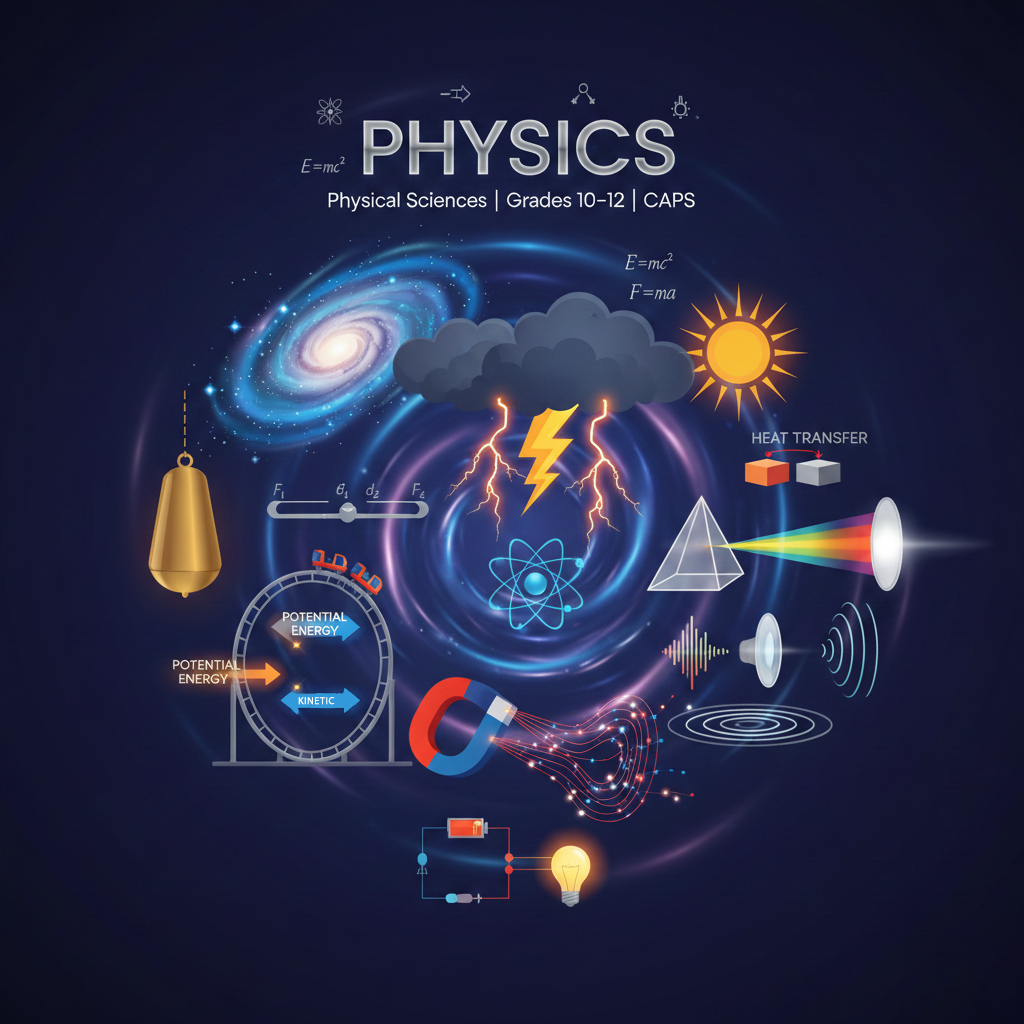
The key content areas covered in the South African Curriculum and Assessment Policy Statement (CAPS) for Physical Sciences from Grade 10 to 12 are broadly divided into Physics and Chemistry, encompassing six main knowledge areas.
Core Knowledge Areas (CAPS)
The entire Grade 10-12 Physical Sciences curriculum is structured around the following six core knowledge areas, which integrate both theoretical and practical skills:
Physics
Mechanics:

Grade 10: Introduction to vectors and scalars, motion in one dimension (kinematics), gravitational potential energy, kinetic energy, and conservation of mechanical energy.
Grade 11: Vectors in two dimensions, Newton’s Laws of Motion and their applications (including different kinds of forces like friction and normal force), and the conservation of mechanical energy.
Grade 12: Momentum and Impulse, Vertical Projectile Motion in one dimension, and Work, Energy, and Power (including the work-energy theorem).
Waves, Sound, and Light:
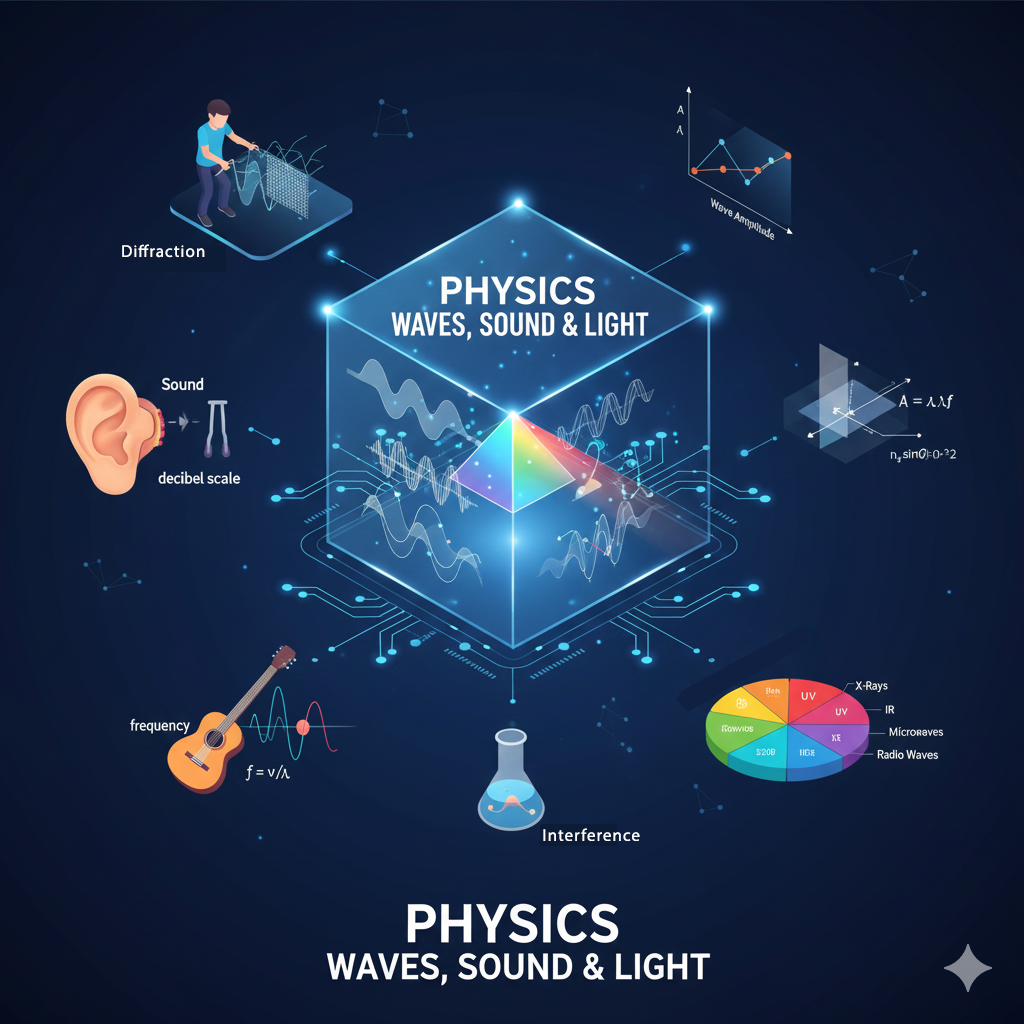
Grade 10: Transverse pulses, transverse waves, longitudinal waves, sound, and Electromagnetic Radiation (the electromagnetic spectrum).
Grade 11: The Doppler Effect (the apparent change in frequency of a sound or light wave), and two-dimensional and three-dimensional wavefronts.
Grade 12: Focuses on Optical Phenomena and Properties of Materials, which often includes the photoelectric effect (sometimes listed as a separate section).
Electricity and Magnetism:

Grade 10: Magnetism, Electrostatics (two kinds of charge, conservation and quantization of charge), and basic Electric Circuits (potential difference, current, resistance, series and parallel resistors).
Grade 11: Electrostatics (Coulomb’s Law, electric fields), Electromagnetism (magnetic field associated with current), and electric circuits.
Grade 12: Advanced Electric Circuits (internal resistance, power, and Ohm’s Law in context) and Electrodynamics (AC and DC generators, electric motors).
Chemistry
Matter and Materials:
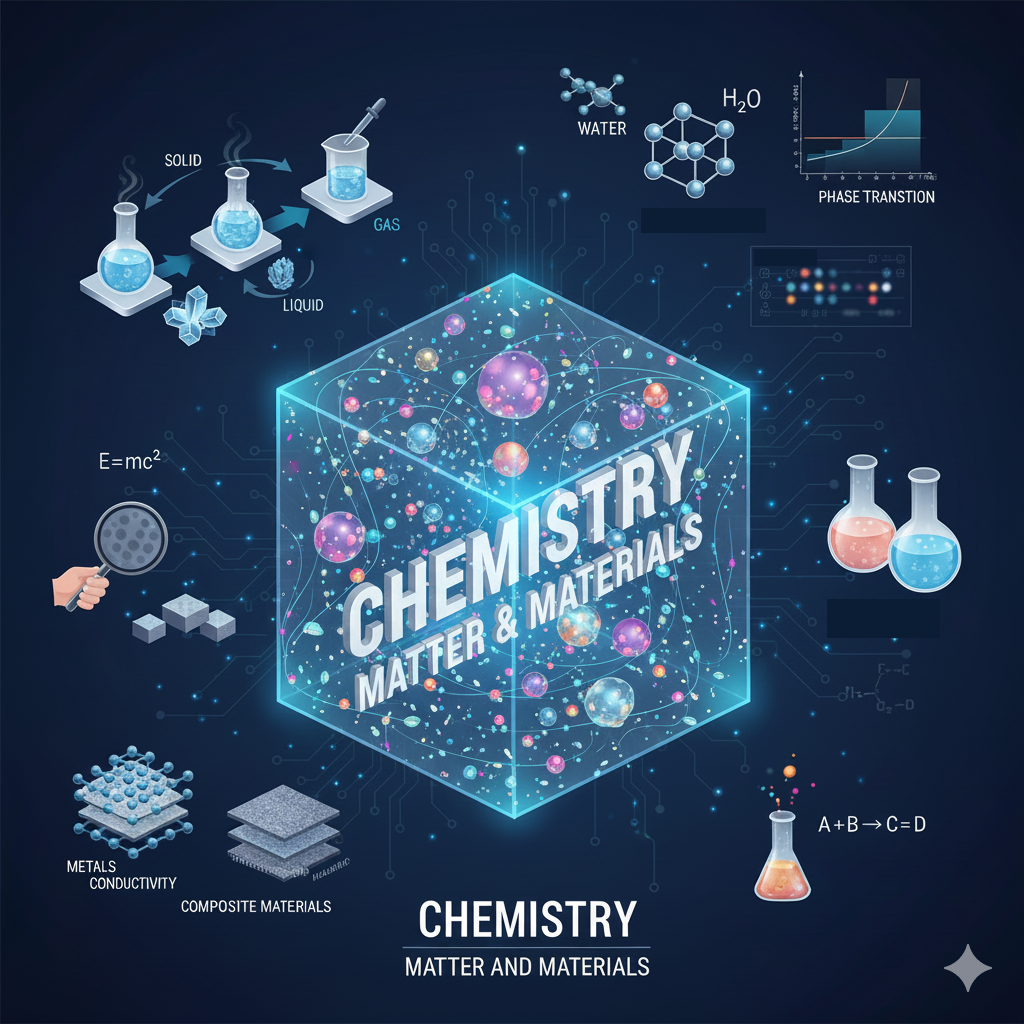
Grade 10: Revision of matter classification, states of matter and the kinetic molecular theory, Atomic Structure, the Periodic Table, and Chemical Bonding (Lewis structures, covalent, ionic, and metallic bonding).
Grade 11: Atomic combinations (molecular structure, shape, and polarity), Intermolecular Forces, and Ideal Gases (gas laws).
Grade 12: Organic Chemistry (naming, structure, properties of hydrocarbons and functional groups) and Organic Macromolecules (polymers).
Chemical Change:
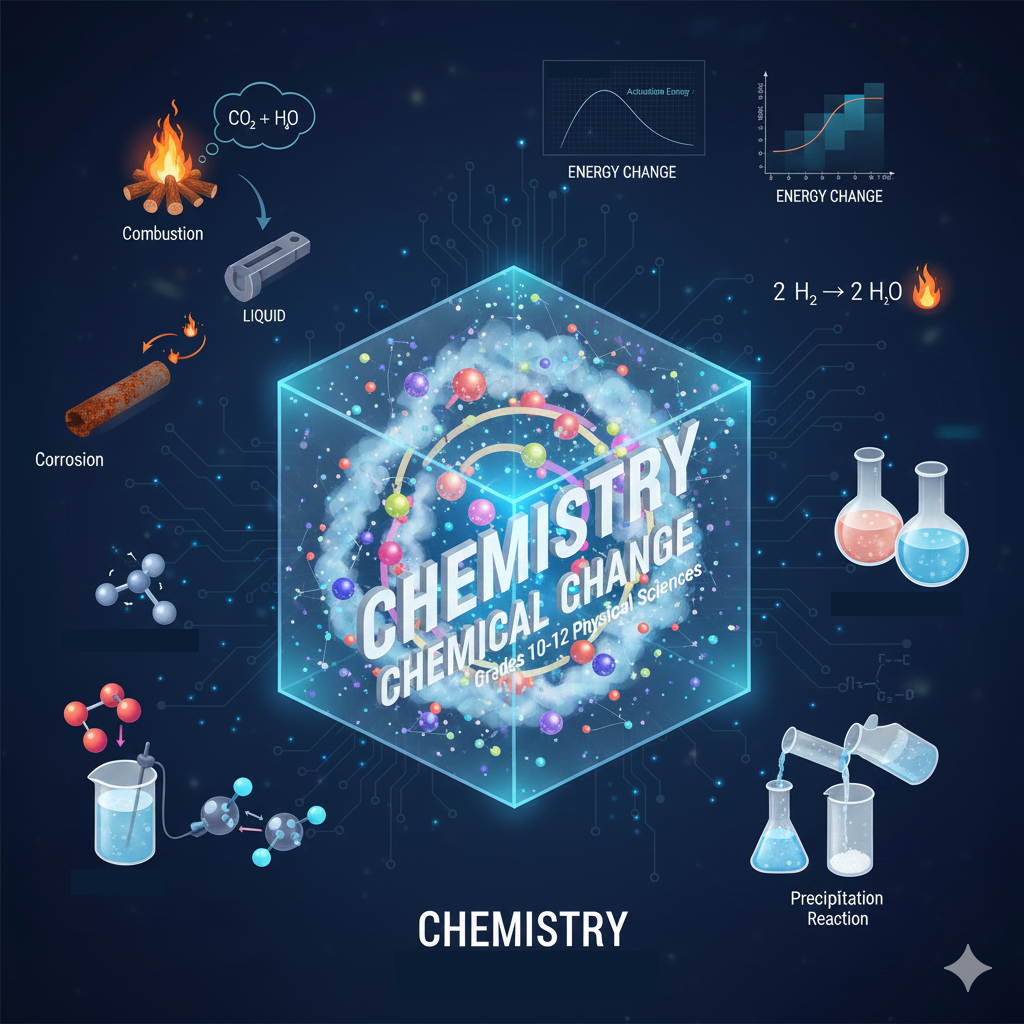
Grade 10: Physical and chemical change, representing chemical change (writing and balancing equations), reactions in aqueous solution (ions, electrolytes), and Quantitative Aspects of Chemical Change (Stoichiometry, atomic mass, the mole, mole calculations).
Grade 11: Stoichiometry (further calculations), Energy and Chemical Change (enthalpy, bond energy), and different Types of Reactions (acids and bases, redox).
Grade 12: Reaction Rate (factors affecting rate, collision theory), Chemical Equilibrium (Le Chatelier’s principle), and advanced Acids and Bases (titrations).
Chemical Systems:

Grade 12: This area is largely focused on Electrochemical Reactions (voltaic and electrolytic cells), which builds on the concepts of redox reactions and chemical change.
Major goals and guiding principles of CAPS for Physical Sciences
The primary goal of the CAPS curriculum for Physical Sciences is to ensure that all learners receive a high-quality education that is both consistent and internationally competitive. In essence, the policy statement aims to equip learners with the scientific knowledge and skills needed for higher education or the workplace.
This national curriculum statement provides a clear framework for basic education, guiding teachers on what to teach and how to assess it. Within the education system, CAPS promotes clarity, depth of knowledge, and a standardised approach, ensuring that every learner has an equal opportunity to succeed in the sciences.
Emphasis on Scientific Inquiry and Critical Thinking
A key principle of the CAPS curriculum for Physical Sciences is fostering scientific inquiry and critical thinking. The curriculum is designed to move learners beyond rote memorisation and encourage them to ask questions, analyse information, and solve complex problems.
This approach creates a dynamic learning environment where learners are active participants in their own education. In South African schools, teachers are encouraged to use practical investigations and real-world examples to help learners connect theoretical concepts to tangible outcomes. This hands-on method makes science more engaging and memorable.
The assessment policy statement supports this by including tasks that test more than just knowledge recall. For example, assessments often require learners to:
- Interpret data from graphs and tables.
- Design simple experiments to test a hypothesis.
Learner Assessment Criteria and Methods
The assessment policy statement within CAPS provides a very clear and structured framework for evaluating learners.
How is the CAPS curriculum different from previous curriculum models?
One significant difference is its detailed prescription of assessment tasks, ensuring consistency across the entire education system and making evaluations more transparent for learners and parents.
For Physical Sciences, a learner’s final grade is a combination of school-based assessments and the final National Senior Certificate (NSC) examination. This approach ensures that academic performance is measured throughout the year, not just in one final test.
The methods used to assess learners include:
- Continuous Assessment: This includes tests, assignments, and practical investigation tasks completed during the school year.
- Final Examination: A comprehensive exam at the end of Grade 12 that covers the entire curriculum for the FET phase.
The national curriculum statement provides detailed, week-by-week pacing guides for teachers.
Improvements in clarity, structure, and outcomes
One of the most significant improvements brought by CAPS is the unparalleled clarity it offers teachers. The curriculum provides a comprehensive policy document for each subject at every grade level, outlining precisely what needs to be taught and when. This has created much-needed consistency across schools.
This structured approach ensures better alignment between what is taught in the classroom and what is tested in exams. The assessment policy statement gives teachers clear benchmarks for evaluating learner performance, which helps in identifying learning gaps early on.
The key improvements include:
- Reduced Administrative Burden: Teachers spend less time interpreting curriculum requirements and more time on planning effective lessons.
- Clearer Learning Pathways: Learners experience a more logical progression of topics from one grade level to the next.
How Teacher and Learner experience has evolved
The introduction of CAPS has notably changed the learning environment for both teachers and learners. For teachers, having clearly defined course guidelines means they can plan with confidence, knowing they are covering all required material in alignment with national standards. This has fostered a more focused and efficient teaching process.
For learners, this consistency means a more predictable and equitable educational journey. Whether a learner is in a rural or urban school, the core curriculum they follow is the same. This inclusive approach is designed to cater to the needs of all learners by providing a stable and uniform foundation.
By standardising the curriculum, CAPS aims to support the diverse needs of learners across the country. This effort toward inclusive education helps ensure that every learner has access to the same opportunities for success, promoting greater fairness and inclusivity within the system.
Conclusion
In summary, the Curriculum Assessment Policy Statements (CAPS) for Physical Sciences represent a significant advancement in educational strategy. By emphasising clarity, structure, and a strong focus on scientific inquiry, CAPS not only enhances the teaching and learning experience but also prepares learners to engage critically with scientific concepts. As we compare CAPS with previous curriculum models, the improvements become clear, showcasing a commitment to better outcomes for both teachers and learners. It is vital for parents to understand this framework in order to support their children effectively. If you have any questions or need further information about CAPS, please don’t hesitate to reach out!
Frequently Asked Questions
What are the main differences between CAPS and other curricula for Physical Sciences?
The CAPS curriculum is a structured, national curriculum with set timelines and exam dates aligned with the South African education system. Other curricula, like Cambridge, offer more flexibility and self-paced learning. The CAPS assessment policy statement is specific to the NSC, whereas international curricula prepare learners for globally recognised exams.
How can parents support learners under the CAPS Physical Sciences curriculum?
Parents can create a supportive learning environment by monitoring their child’s progress, assisting with challenging topics, and encouraging a consistent study routine. Encouraging participation in science-related extracurricular activities can also boost engagement and improve the academic performance of learners, making their schooling experience more enriching.
Is there online support or schooling for Physical Sciences using CAPS in South Africa?
Yes, Doc Scientia offers the full CAPS curriculum for Physical Sciences, online eBooks and courses can be accesses here: https://docscientia.co.za/courses-eng/.
These options provide structured lessons, teacher support, and assessments, allowing learners to complete their schooling from home and often work at their own pace while still following the national curriculum.