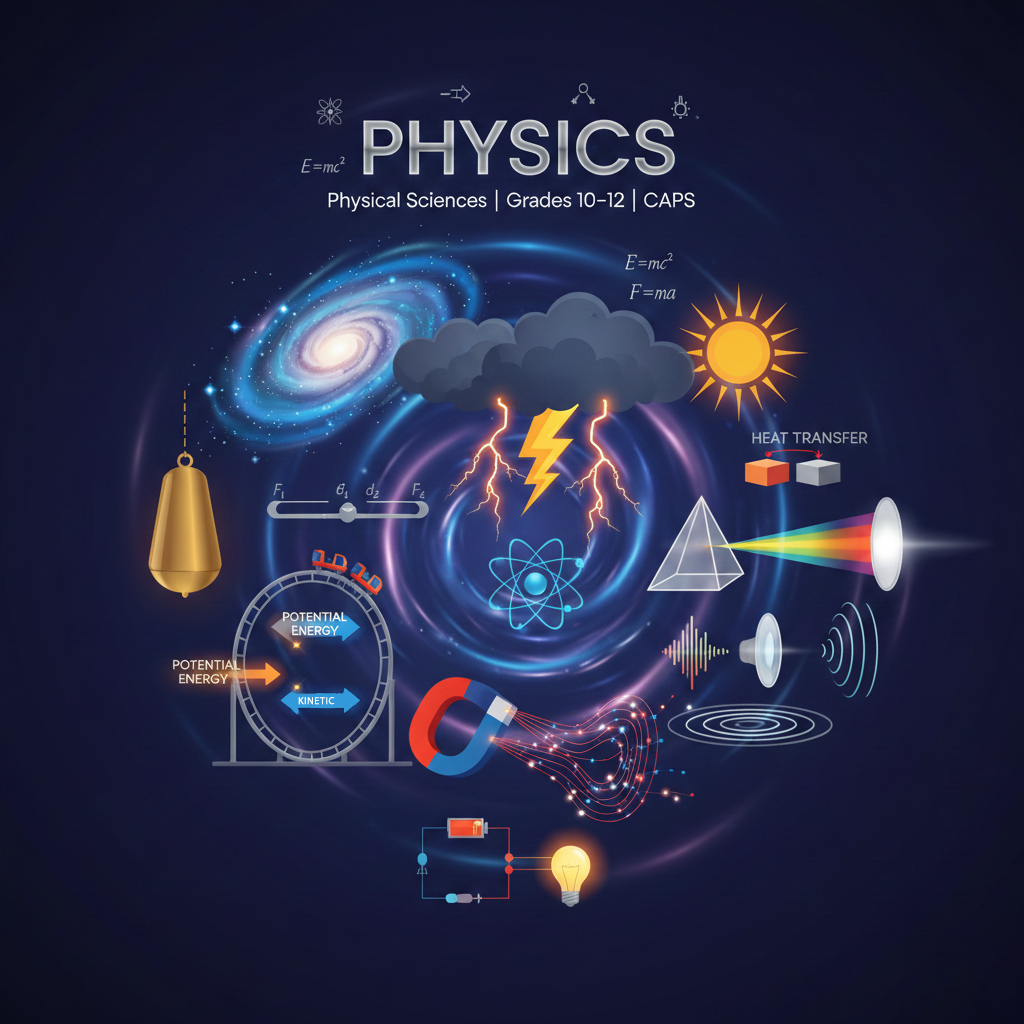
Physics CAPS – Key Highlights
- This guide provides a detailed look at the Physics CAPS curriculum for South African learners in Grade 10 – 12.
- The Further Education and Training (FET) phase, starting in Grade 10, marks a significant step up in your academic journey.
- Physical Sciences is a key elective subject that opens doors to many future career paths.
- Success in your final years depends on using resources like past exam papers and memos for effective revision.
- The curriculum builds foundational knowledge toward the National Senior Certificate.
Introduction
Welcome to your guide for navigating the Physical Sciences curriculum in South Africa! If you’re a Grade 10 or 11 learner, you know that these years are crucial for building a strong academic foundation. Physical Sciences, especially Physics, can be challenging but also incredibly rewarding. This guide is here to help you understand the CAPS framework, what you’ll be learning, and how you can use available resources to succeed. Let’s get you prepared for a future of exciting possibilities.
Overview of Physics CAPS curriculum for Grade 10 and Grade 11 in South Africa
The Curriculum and Assessment Policy Statement (CAPS) provides a structured framework for all subjects, including Physical Sciences. For learners in South Africa, this means your educational path is clearly defined, ensuring you gain the necessary skills and knowledge each year. The curriculum is designed to build on itself, with each grade preparing you for the next level of complexity.
Understanding this structure is your first step toward success. As you move from Grade 10 to Grade 11 and finally Grade 12, the topics become more advanced, requiring greater dedication. Knowing what to expect from CAPS exam papers, especially for Physics, and how the content progresses will help you plan your studies and feel more confident.
Structure and key outcomes of the CAPS system
The CAPS system for the FET phase (Grades 10-12) is designed to give you a well-rounded education while allowing for specialisation. Grade 10 is the starting point where you focus on seven subjects. This structure requires you to balance compulsory subjects with electives that match your interests and career goals. The goal is to develop critical thinking and problem-solving skills, which are essential for your final exams.
A key outcome is to prepare you for the end-of-year exam papers, which test your understanding of the entire year’s work. The system encourages consistent effort, with assessments spread throughout the term. For learners, this means staying on top of your workload is vital.
Your subject choices in Grade 10 are a mix of required and elective courses. Here is a typical breakdown:
|
Compulsory Subjects |
Elective Subjects (Choose 3) |
|
English Home Language |
Physical Sciences |
|
First Additional Language |
Life Sciences |
|
Mathematics or Mathematical Literacy |
Geography & History |
|
Life Orientation |
Business Studies, Accounting, Economics |
Physics – Grade 10, Grade 11, and Grade 12 curricula
The CAPS-aligned core knowledge areas for Physics (Paper 1 of Physical Sciences) follow a logical progression, moving from foundational definitions and descriptive concepts in Grade 10 to advanced laws, calculations, and modern applications in Grade 12.
Here is a breakdown of the key differences and the progression of topics:
Grade 10: Introduction and foundations
Grade 10 focuses on the basic concepts, definitions, and qualitative descriptions of all four main physics knowledge areas, establishing the necessary vocabulary and observational skills.
|
Knowledge Area |
Grade 10 Focus (Foundational/Descriptive) |
|
Mechanics |
Motion in One Dimension (1D): Basic definitions of position, distance, displacement, speed, velocity, and acceleration. No complex force problems. Scalars and Vectors: Introduction to the difference between them. Energy: Introduction to Gravitational Potential Energy and Kinetic Energy. The Atom: Basic atomic structure and charge. |
|
Waves, Sound & Light |
Transverse and Longitudinal Waves: Definitions of basic concepts like pulse, amplitude, wavelength, frequency, and period. Sound: Describing sound as a longitudinal wave and relating pitch/loudness to frequency/amplitude. Electromagnetic Radiation: The electromagnetic spectrum and calculating photon energy. |
|
Electricity & Magnetism |
Basic concepts of charge, conservation of charge, quantisation of charge and charging by friction. Electric Circuits: Basic definitions of potential difference, current, resistance, and calculating total resistance in simple series and parallel circuits. |
Grade 11: Laws and quantitative application
Grade 11 transitions from descriptions to laws, diagrams, and quantitative problem-solving in Mechanics and Electricity, introducing vector analysis in two dimensions.
|
Knowledge Area |
Grade 11 Focus (Laws/Quantitative Application) |
|
Mechanics |
Vectors in 2D: Resolving vectors into components, and graphical vector addition (tail-to-head method). Newton’s Laws of Motion: First, Second, and Third Laws. Application to complex systems (e.g., objects on slopes, friction, and two-body systems using free-body diagrams). Newton’s Law of Universal Gravitation: Calculating the gravitational force between two objects. |
|
Waves, Sound & Light |
Waves: Review of Grade 10 concepts. |
|
Electricity & Magnetism |
Electrostatics: Moving from simple charge to Electric Field concepts (field lines and calculating electric field strength. Electric Circuits: Deeper application of Ohm’s Law and power/energy calculations. Electromagnetism: Introduction to the magnetic field around current-carrying conductors, and the operation of simple DC Motors. |
Grade 12: Momentum, Energy, and Modern Physics
Grade 12 focuses on deepening the understanding of Mechanics principles through conservation laws, applying advanced concepts to real-world phenomena (like the Doppler Effect), and introducing Modern Physics.
|
Knowledge Area |
Grade 12 Focus (Conservation Laws/Advanced Concepts/Modern) |
|
Mechanics |
Momentum and Impulse: Definition, Principle of Conservation of Linear Momentum, and calculating impulse. Vertical Projectile Motion (1D): Analysis using motion graphs and equations, focusing on objects under gravity alone. Work, Energy, and Power: Work-Energy Theorem and Principle of Conservation of Mechanical Energy (including non-conservative forces like friction). |
|
Waves, Sound & Light |
The Doppler Effect: Definition and application to sound, explaining pitch change due to relative motion. |
|
Electricity & Magnetism |
Electric Circuits: Advanced circuit analysis, including the effects of Internal Resistance in a battery, and Terminal Potential Difference. Electrodynamics: Principles of Electromagnetic Induction (Faraday’s Law), the operation of Generators (AC and DC) and the concept of RMS values in AC Circuits. |
|
Matter & Materials | Photo-electric Effect |
Introducing the quantum nature of light (photons) and the concept of work function. Emission and Absorption Spectra: Using spectral lines as evidence for energy levels in atoms. |
Summary of Progression
The progression can be summarised as:
- Grade 10:Defining and describing the basic properties of motion, waves, charge, and circuits.
- Grade 11:Applying fundamental laws (Newton’s Laws, Universal Gravitation, Electric Field) and introducing vector resolution to solve more challenging, quantitative problems.
- Grade 12:Applying conservation principles (Momentum, Mechanical Energy) to complex dynamic systems, exploring electromagnetic induction, and introducing the concepts of Modern Physics.
Required textbooks and study materials
Having the right study materials is essential for mastering Physical Sciences. Your school will provide a list of prescribed textbooks that are aligned with the CAPS curriculum. These books are your primary resource, as they cover all the topics in the required depth and prepare you for what to expect in assessments. You can often find downloadable lists in PDF format to ensure you have the correct editions.
Beyond textbooks, a wealth of supplementary materials can aid your revision. It’s a good idea to collect past CAPS exam papers and their corresponding memos. Working through these helps you get familiar with the exam format and the types of questions you will be asked.
Many online platforms also offer structured notes, video lessons, and practice quizzes. Have a look at the Physics material on Doc Scientia’s website: https://docscientia.co.za/subject/physical-sciences/
Conclusion
In conclusion, the Physics CAPS curriculum for Grade 10 ,11 and 12 is designed to equip learners with a solid foundation in Physical Sciences. By understanding the structure, core topics, and available resources, learners can navigate their studies more effectively. Utilising recommended textbooks, online platforms, and past exam papers will enhance preparation and boost confidence. Remember, staying organised and proactive in your studies can lead to success in mastering Physics concepts. If you have any questions or need further assistance, feel free to reach out, and let’s make this academic journey a rewarding experience together!
Frequently Asked Questions
Can I access past National Senior Certificate exam papers for Grade 10 and Grade 11?
While the National Senior Certificate (NSC) is a Grade 12 qualification, learners can find past provincial or school-based exam papers for Grade 10 and 11. These are excellent for practice and are often available online in PDF format with memos, helping you prepare for the format of the final NSC exams.
What strategies help prepare effectively for Grade 10 Physical Sciences exams?
Effective preparation involves creating a study schedule, practicing daily revision, and working through past exam papers and testpapers. Don’t hesitate to ask tutors for help with difficult topics. This disciplined approach applies to all subjects, from Physical Sciences to Business Studies, and is key to achieving good results.